What bothers you is your business. I have no choice, whether I like it or not. I live in downtown Budapest. I take off my shoes at home, put my clothes in the wash, and take a bath. I have to do something with my bare soul too. My self-refreshing tools: a few pens, a bottle of ink, A4 and A3 sheets of paper, a pencil, white chalk, a razor blade. (I use the latter to correct the ink lines a little. Not much.)
I am disturbed by people who are called homeless. I would like them to be well-off. To live properly, like everyone else. Obviously, I cannot solve this problem. I am forced to accept their degraded situation. They are part of the city, just as they are.
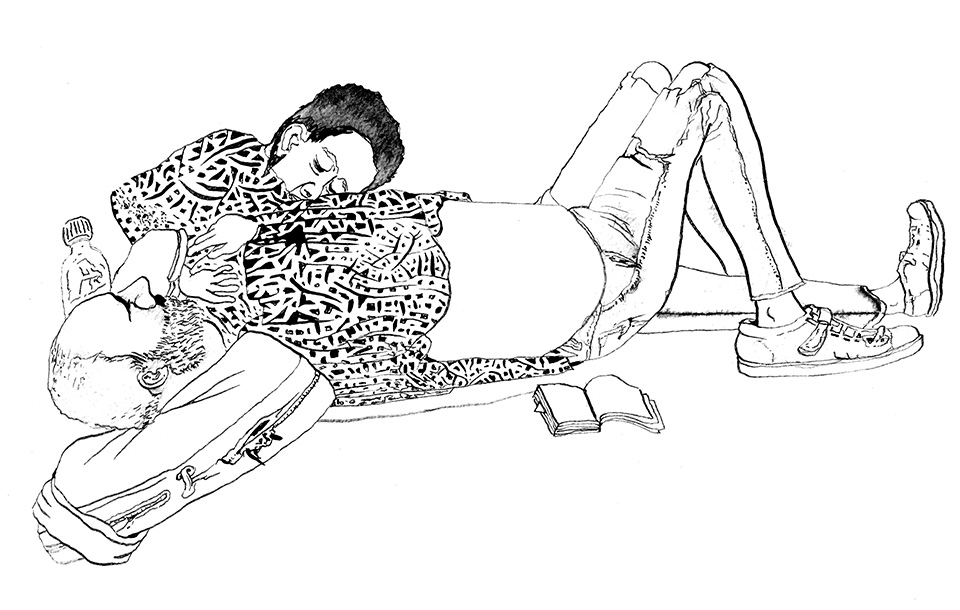
Of course, I don’t touch anyone’s property, but I often draw on the same corrugated cardboard they lie and sleep on. Discreetly—so as not to be intrusive—I make sketches of them, which I then draw “properly,” so to speak, after I’ve moved away. In one go.
I read that artists are “angels’ spies.” They represent the things of the world—with the revelations of folk tales—perhaps as the Creator’s closest collaborators.
This shows the risks involved in grappling with seemingly unsolvable problems that affect many people. These drawings are a kind of record of the “facts.” Here and there, the swirling of the sad surfaces draws us into textures that bear no resemblance to the original model, but rather reveal the artist’s longing.
There is encouraging news that seems utopian. Experiments are underway to produce clothing that uses nanotube technology to generate electricity from the mere movement of the wearer. This has already been used to charge mobile devices simply by walking. I believe that sound emissions, even everyday speech, can be transformed into energy. The words of a beggar can immediately become productive power.
I have already heard that this has been achieved: in Japan, solar-powered public benches have been created that collect enough solar energy during the day so that homeless people can lie down on heated street furniture free of charge at night.
Gábor Szerényi