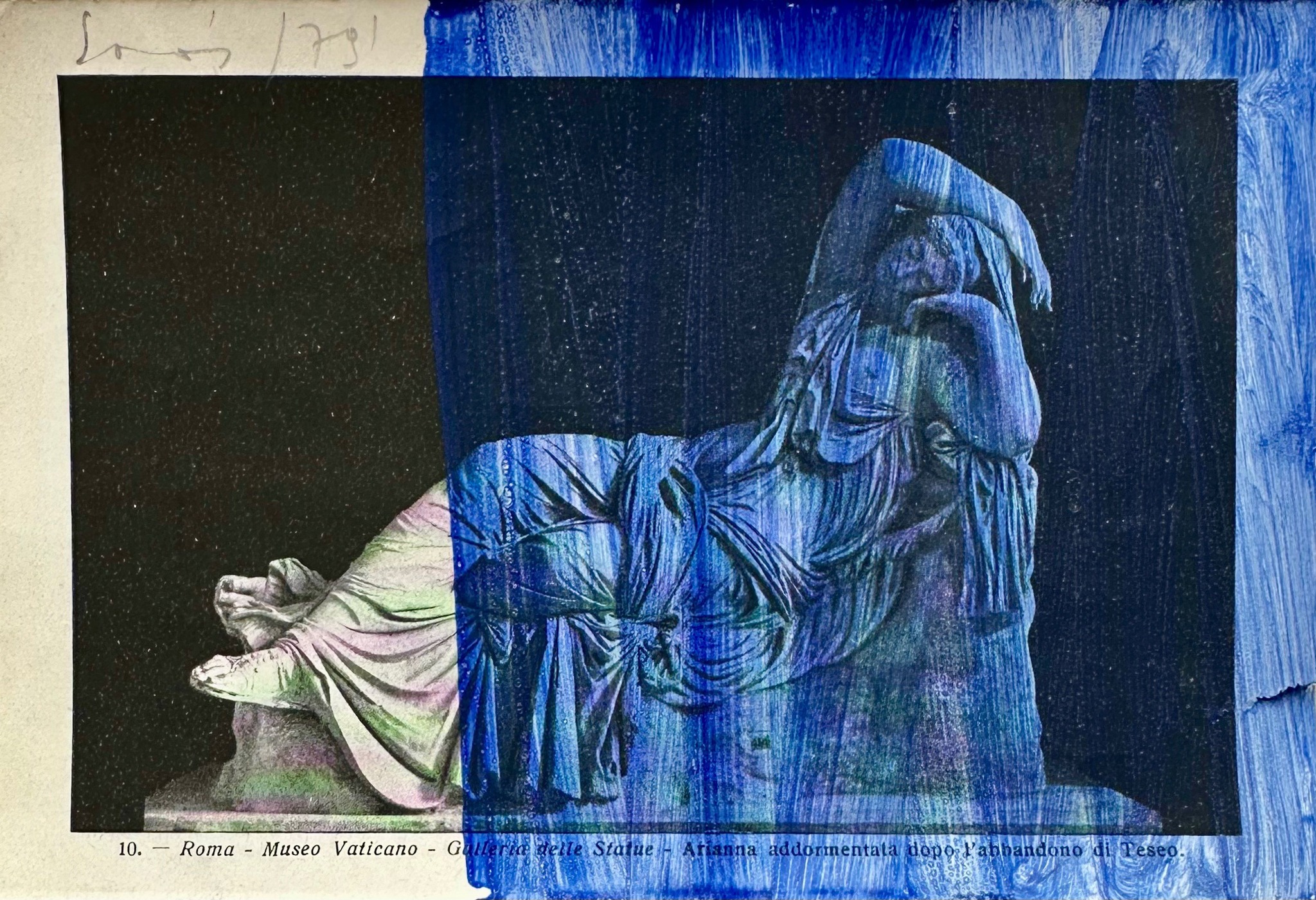
Tamás Soós’ work is characterized by perpetual changes, as well as by a peculiar coexistence and simultaneity of different forms of expression. His interest ranges from reflective gesture painting to meditative (monochromatic) works, completely stripped of all meaning yet producing fully charged and highly personal spaces; from the imaginative stylistic metaphors of “quasi-Baroque” and Mannerist influence, abounding in art historical references and stylistic paraphrases, to the “Baroque Melancholies” which start out from the basic situation of a world without myths, and which is free of all pathos while being frivolously and impersonally decorative. He seems to have no difficulty passing from one artistic period to the next and from one system of forms to another, moving between his own stylistic metaphors ingeniously and with an apparent ease.
For every new period, he comes up with a new answer to the stylistic problems; for every new method he offers an “option” to create a new metaphor which is both valid, personal and reflective. Soós refuses to accept any taboos or proscriptions (in this respect his art is in line with the Postmodern concepts); he goes even further by refusing to accept any unappealable judgements, rules or obligatory sets of values. Nor does he accept precisely outlined and strictly defined areas for research either, since research as an analytical approach to the possible forms of art is itself irrelevant to him.
Soós’ work is based precisely on the method of free passage between the various fields, rather than on researching or surveying one particular area . He regards art as a kind of open pasture in the history of culture and styles, to be roamed freely by artists in true nomadic fashion; his encampments, his temporary settlements in open territories, demonstrate the relativeness of boundaries, the non-evolutionary complexity of cultural-historical developments and the conditionality of the different systems of values, Soós uses the various stylistic metaphors, not in a formal sense but in the sense of appropriating the systems of values and the philosophical structures inherent in them.
The unusual and provocative inconstancy of his art (which people often find confusing), the variability of his works, both in form and in vocabulary, are not due to a capricious streak in Soós’ personality; rather, it originates in the demand felt by the artist to always address problems that are real and current. He always tries to respond to the given intellectual situation, and in doing so, he does not hesitate to use – as analogies or as cultural connotations not readily verbalized – the different layers of meaning hidden behind the visual topos. He presents us with visual objects, which, in their capacity as visual facts and by virtue of their own formal and semantic structures, make us aware of a particular situation. Instead of looking for universal analogies, his art is better approached from the direction of the individual object’s power to increase our sensibility and perceptiveness.
In the 1970s Tamás Soós was interested in pseudo-structuralist problems. Nevertheless, his painting already contained some uncontrolled and improvisational elements back then, which eventually came to open a new phase in his art. He started out from a systematically conceived and examined calligraphic painting, but soon turned his back on the analytical forms of art and made attempts to express his subjective self-image in terms of stylistic metaphors. He created pure gesture paintings, in which the graphical qualities were gaining in importance. Immediately after developing the improvisational and informal method of painting, he introduced a number of new compositional elements and symbolic forms of cultural historical origin.
In his series entitled Mythology, the antique motif, “The Judgement of Paris” is combined with the Christian motif, “St. John the Baptist”, in such a way that both interpretations are projected onto the artist himself and the meanings describing the sensation of the spontaneous and fleeting psychological state associated with the calligraphic transformation of the surface are actualized. At the same time, he invests the motifs with personal and individual qualities. Soós also discovered the “Hannibal story” which served to him as a metaphor of certain attitudes as well as of answers given to various moral and historical problems, and which he used in a number of his oil paintings and watercolours.
In this period, Soós’s oeuvre was based on the picturesque and imaginary world of a culture which, in that particular form, had never existed, and which came complete with its own heroic figures, ideas, dynamic art and colourful and chimerical architecture. A fine and complex colourism entered his painting, along with a kind of mannerist decadence: hedonism and ornamentalism to screen off the deeper feelings and dramatic gestures. While his ornamentalism was increasing in his small scale drawings and paintings, through its multiple meanings, symbolic references and art historical motifs, his emotionally charged thematic world came to express an artistic totality based on the impersonation of the “cultural metaphor”. This artistic programme enabled him to demonstrate the authenticity of his search for a new identity.
This is the viewpoint from which Tamás Soós’ art should best be evaluated. His works have come to be regarded as the aesthetic forms of the free discovery of the artistic Self, the subjective pictures of his search for totality. And the only works that can inspire us with such notions are those which are authentic, powerful and have internal order. With its neo-Baroque Naturalism and strange painterly qualities, “Caravaggio” meant a turning point in Soós’ art. Painted in 1985, this particular work was the first of the artist’s subsequent series of stylistic metaphors combining ‘quasi-Baroque’ elements with art historical references.
It was in a round-about way, through the theatrical effects of deliberately amassed “artificial” elements, that his series of paintings re-interpreting the topos of “Heroic Landscape” reached the truly deep feelings: the realization of the common source of life and art, of destiny and free will. The dramatic pathos, loftiness and theatricality of Baroque style, which played such a prominent role in the history of art in Central Europe, was incorporated in Soos’ visual world in such a way that it brought with it the sentimentality and radicalism associated with the “stormy past”, while the passionate strive for majesticity was ironically reduced immediately, making everything relative: the subjects of individual evaluation and choice.
(Excerpt from Lóránd Hegyi’s essay titled The Possibilities of Metaphorical Forms)