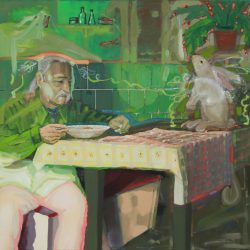
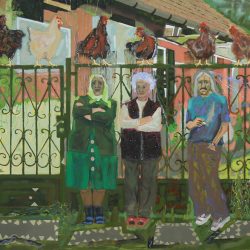
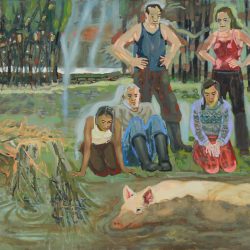
A significant master of contemporary Hungarian fine arts from an international perspective lives and works in Mezőszemere, a village in Heves County. Imre Bukta (1952) began his career as a self-taught artist in the 1970s. His art is strongly linked to the lifestyle and culture of Hungarian people living in rural areas and working in agriculture. From the outset, his themes have been the objects, places, and people of everyday working life, which he depicts using a wide variety of media: he freely uses all kinds of natural materials that come to hand (hair, wood, corn, tiles, matchsticks, etc.), which he assembles in an assemblage-like manner.
In his objects, installations, and performances, he places everyday tools of peasant material culture side by side in a self-evident way, or builds unique visual-mechanical structures out of them. His portraits, compositions, and scenes can be understood as special sociological studies, except that, in contrast to the outsider’s detached analytical perspective, Bukta sees and shows this peculiar world, fraught with bittersweet overtones, from within. His approach is sometimes ironic, sometimes melancholic, sometimes (socio)critical or permissive, but he always approaches his subjects with exceptional empathy.
Imre Bukta’s latest paintings (2025-26) depict domestic animals and field animals that were once typical of the Hungarian countryside, and of course us, the people of today. What if, on a beautiful village evening, we encountered a cow walking home, or a pig wallowing in the mud and grunting happily? There are no cows left in the village where the artist lives, but he works in a former cowshed – the aura is unmistakable. Different smells, different sounds, different people. Childhood memories deeply embedded in the canvases mix with the realism of today.