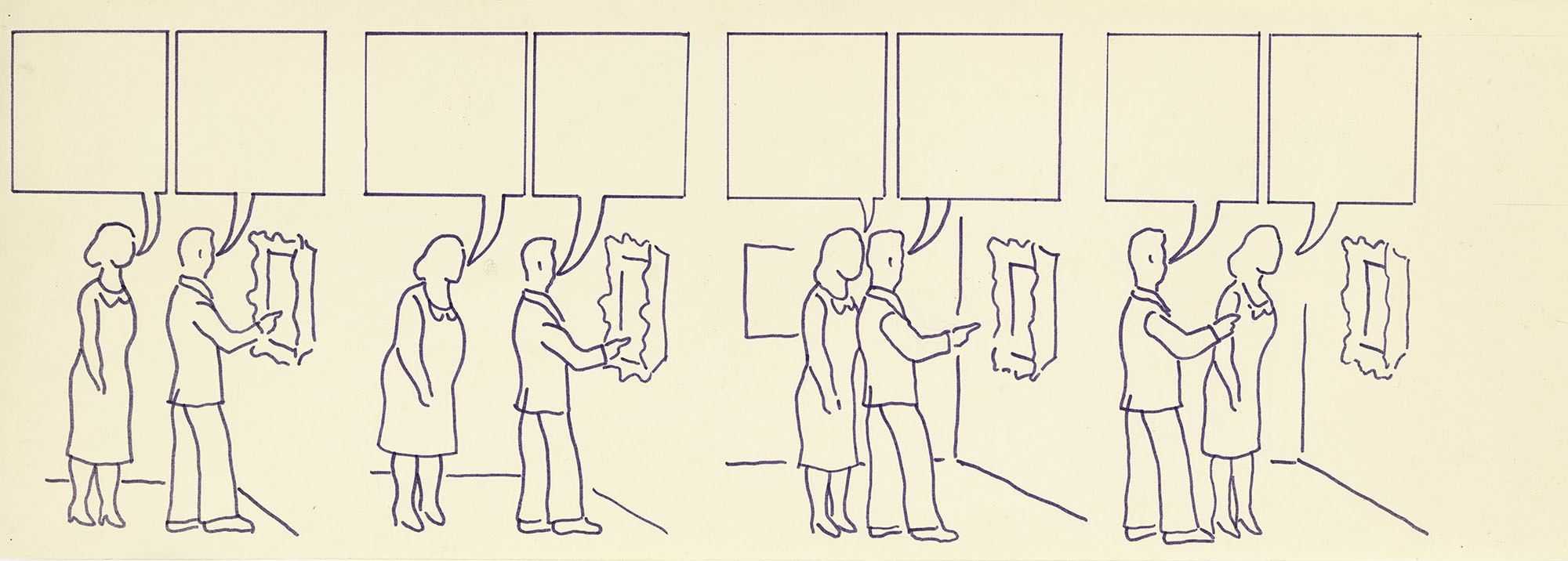
Catastrophe Situations presents Ákos Birkás’s previously almost unknown comic strip-format works, which were last exhibited around half a century ago. The eponymous series was created in 1978, parallel to the conceptual photographic works Image and Viewer, which concluded Birkás’s three–year–long, grandiose project examining the theoretical and practical relationships between the viewer and the artwork, as well as between text and image, through the lens of the Museum of Fine Arts. the viewer and the artwork, and the theoretical and practical relationship between text and image, through the Museum of Fine Arts.
While the Image and Viewer series was aimed, half ironically, half seriously, at the most direct form and highest degree of involvement in the work, in Catastrophe Situations, which can be interpreted as its counterpart, viewers approach the zero degree of immersion. Just as in the Image and Viewer series we see the viewer standing with their back to the image like Friedrich’s Rückenfigur, in Catastrophe Situations Birkás also doubles the depicted situation: he creates a wide variety of variations and interpretations of the single basic situation in which a man and a woman try to interpret a panel image indicated only by contour lines in the drawing.
At the same time, it seems as if each of them suggests that, like the viewers of these comic books, the characters are looking at the image but do not actually see it, monologuing with a projection or reflective surface instead of engaging in dialogue. Instead of the rounded speech bubbles commonly used in comics, the viewers’ lines are written in “text blocks” the same size as the panels, meaning that the drawings themselves convey how textual panels can become equivalent to visual panels: the artwork becomes readable, understandable text, while the text becomes a textual layer written onto the surface of the work.
At the same time, it seems as if each of them suggests that, like the viewers of these comic books, the characters are looking at the image but do not actually see it, monologuing with a projection or reflective surface instead of engaging in dialogue. Instead of the rounded speech bubbles commonly used in comics, the viewers‘ lines are written in “text blocks” the same size as the panels, meaning that the drawings themselves convey how textual panels can become equivalent to visual panels: the artwork becomes readable, understandable text, while the text becomes a textual layer written onto the surface of the work.
Birkás’s other comic book series, the 1979 Frustration Test (Text Deletion), also thematizes the “frustrating” conflict, even “catastrophic” collision, between visuality and textuality, painting and speech, but with the opposite power relations. While in Catastrophe Situations the text overwrites the painting, in Frustration Test the painting overwrites the text. On the one hand, the series subjects its characters to various “frustration tests,” and on the other hand, it also subjects the viewers, insofar as it almost completely paints over the texts that presumably transform the tension of the scenes into humor with an expressive gesture, rendering them illegible and extinguishing them. At the same time, Frustration Test is also an imprint of Birkás’s own growing frustration with “text,” on the one hand with conceptual art, and on the other with the influence of various theoretical texts on art, which over the course of a few years gradually led to the “anti-text” expressive new painting and the Head series.
Barnabás Zemlényi-Kovács