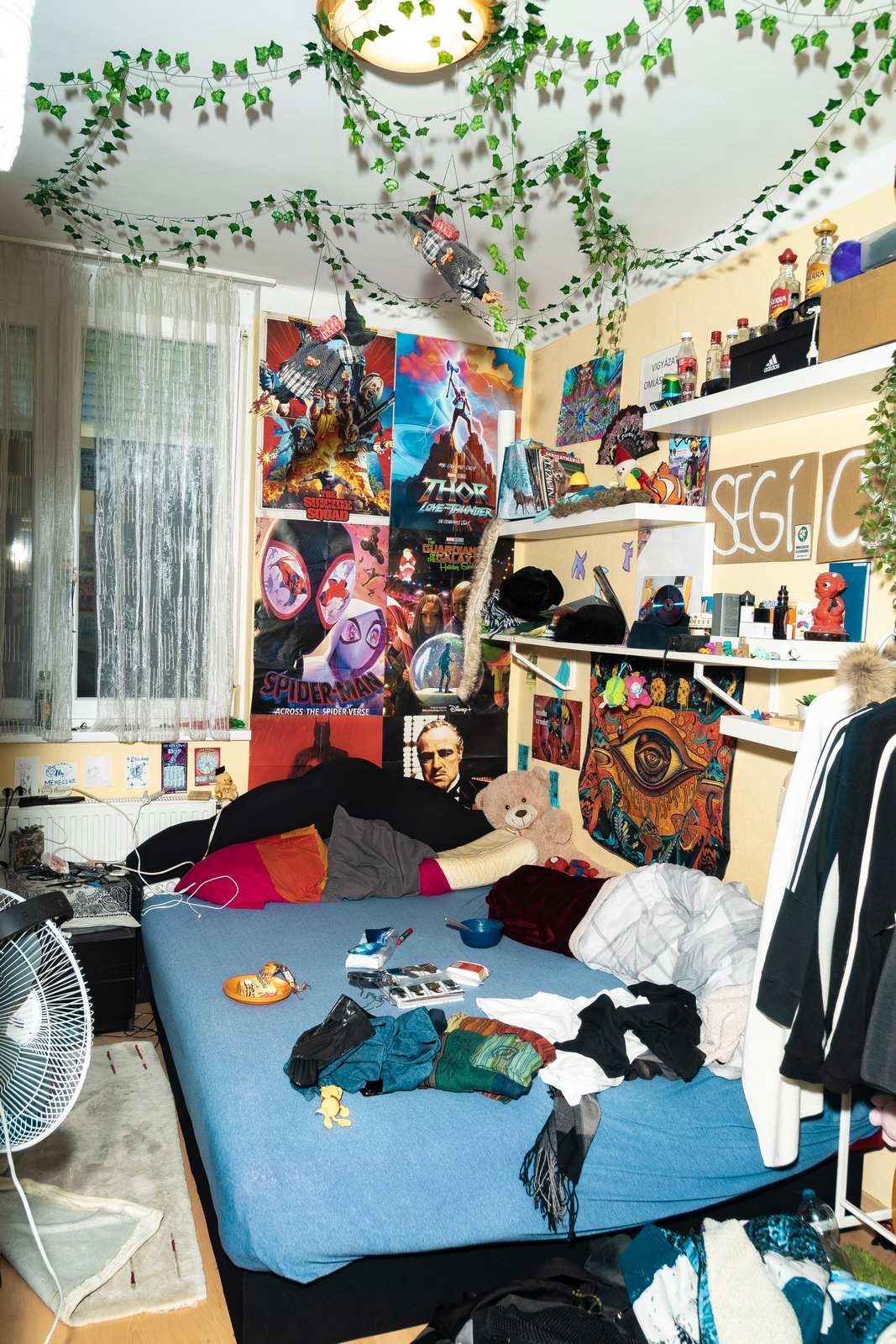
But do you like me? is a long-term photography project that explores the transitional stages of contemporary adolescence. The series was born out of personal motivation: Emma Szabó, a young mother, draws on her own memories – and lack thereof – to turn her attention to Generation Z and Generation Alpha. The question is not only how we see the young people of our time, but also what patterns, tensions, and unexplored legacies are repeated from generation to generation.
The project began with a kind of homecoming: the photographer visited her former high school to visually reinterpret her memories. In 2024, the process gained new momentum when Szabó was awarded the Budapest Photography Scholarship. The grant enabled the series to continue over a longer period of time with greater depth, allowing a more complex and layered research process to unfold from the emerging relationships. The project is not simply a collection of images, but a gradually constructed space of trust in which the participants’ stories become denser and more nuanced over time. Through her camera, she follows them with attentive sensitivity, creating an atmosphere in which trust and vulnerability become the internal tension of the images.
The car, as a recurring motif, appears as a site of transit, a temporary refuge where the boundaries between private and public dissolve, and the performative process of identity reveals itself in more intimate layers.
The project is closely intertwined with the artist’s academic work: Emma Szabó is currently pursuing her MA studies in Photography at Moholy-Nagy University of Art and Design. In her thesis, she examines the interconnections between generational ruptures, family systems, and the identity-shaping effects of online presence through visual narratives, primarily in contemporary Hungarian documentaries (KIM, Divák, KIX). The series also draws from this reflective background; it does not offer a closed narrative, but rather creates open situations in which viewers enter into dialogue with the images through their own experiences.
But do you like me? is therefore not merely documentation, but a sensitive generational dialogue: a visual space in which past and present, memory and emerging identity, layer into one another.