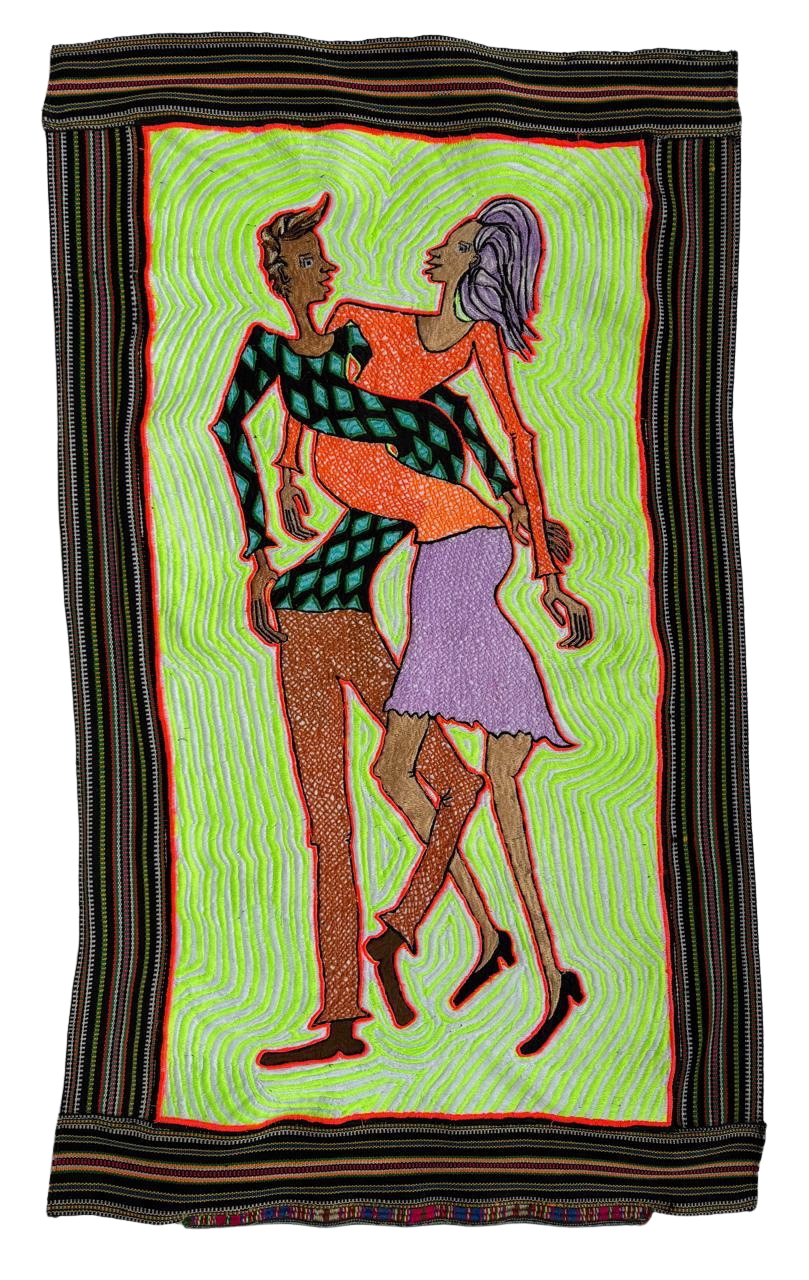
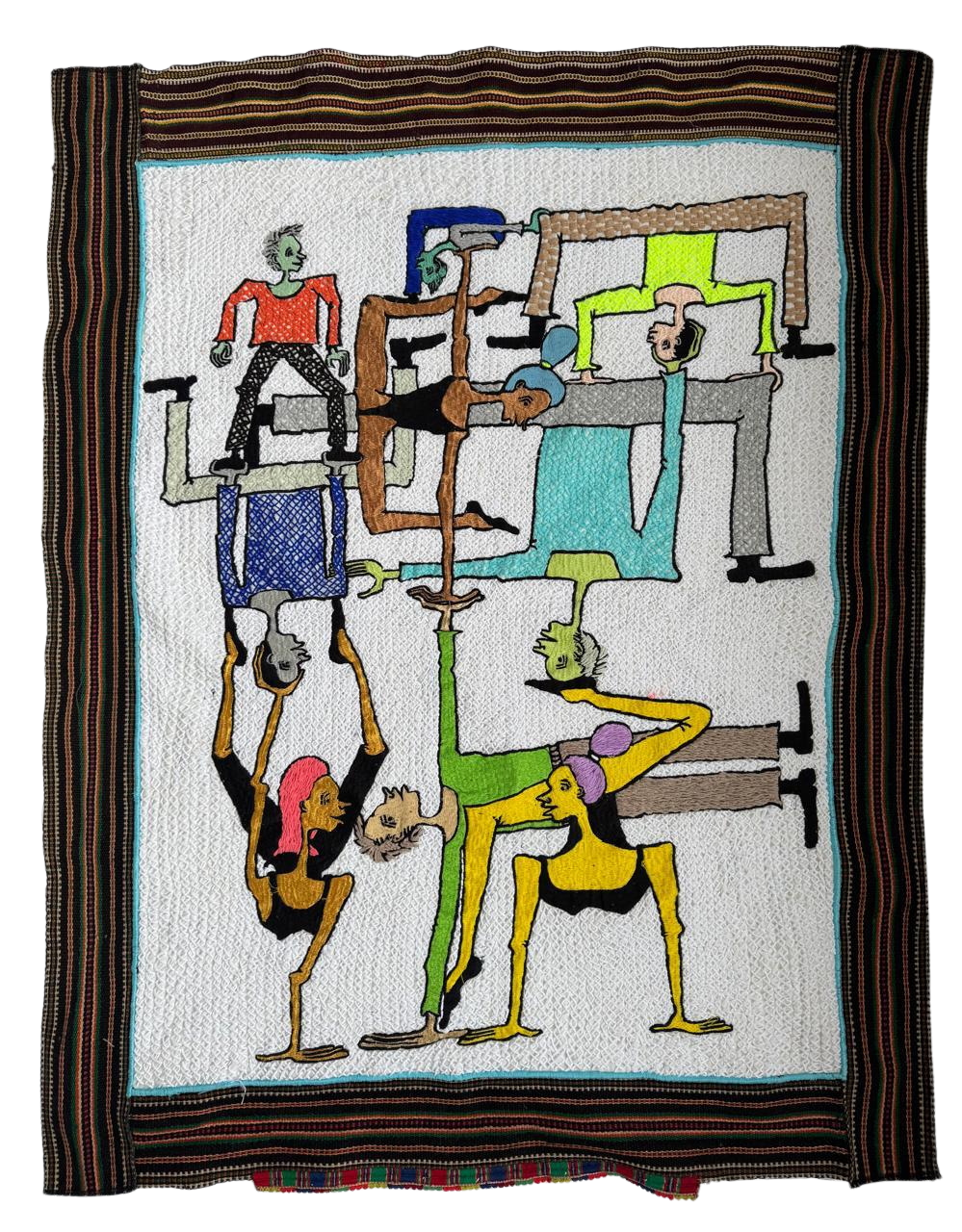
The exhibition RUB-A-DUB-DUB marks the first debut solo exhibition in Hungary of the Kosovar artist Jakup Ferri, represented by Ani Molnár Gallery. The internationally acclaimed artist now presents an expansive solo show offering insight into his vivid multifaceted, cross-media practice. The exhibition brings together previously unseen textile works as well as oil paintings and embroideries from his ongoing We We series, providing a comprehensive view of Ferri’s artistic language.
Jakup Ferri’s artistic practice is widely recognised for its vibrant paintings and embroideries, in which encounters between everyday people, animals, and hybrid creatures unfold. The presentations often take form as an immersive environmental installations that weave across entire spaces, encompassing the viewers. Ferri’s compositions are frequently structured around absurd yet playful narratives that draw attention to the clumsiness of everyday life and the fundamental absurdity of existence.
His grotesque, childlike visual language and material sensibility equally inspire by Kosovar folk art and the traditions of outsider art. For Ferri, carpet- making — an artistic medium that has gained renewed prominence in global contemporary art scene in recent years — is not merely a form of expression, but a social and communal practice. It activates traditional crafts while contributing to the preservation and transmission of collective memory within the context of contemporary art.
Ferri has been working with textiles for nearly two decades, employing a range of techniques including gobelin tapestry, tentene lace, and cross-stitch embroidery. His works frequently emerge through collaborative processes: he works closely with seamstresses and artisans from Kosovo and Albania, who contribute to the realisation of the carpet designs.
These different forms of handcraft do not merely vary in appearance; each carries its own rhythm, density, and tactile sensibility, subtly shaping the visual and material presence of the works. Ferri’s textile-based practice also connects to a multi-generational artistic lineage. His father, the artist Rexhep Ferri, was also experimenting with textile throughout his career, and in the project Tintirinti, carpet patterns were developed from drawings by his young son, Jip.
Ferri’s pictorial universe unfolds within a distinctive, flattened spatial logic: figures and scenes appear entirely in two dimensions, as though organised within an archaic visual system reminiscent of the compositional principles of Egyptian wall paintings. Within these compositions, acrobatic bodies often appear interlocked in almost mechanical configurations, intertwining in movements that seems choreographed.
The scenes evoke, at once, a Busytown Mysteries sequence and the illogical yet strangely systematic order of a psychotic dream image. This ambiguous atmosphere is echoed in the exhibition’s title, RUB-A-DUB-DUB — an onomatopoeic English nursery rhyme with deep historical roots, whose playful rhythm subtly resonates with the surreal logic of Ferri’s visual world.
Behind the fundamentally light-hearted and playful tone of Ferri’s works, a subtle and understated political layer unfolds. His intimate scenes evoke the cultural isolation and peripheral condition of his homeland, while focusing on small, enclosed communities — families, friendships, and networks of relationships. The complexity and tragedy of Kosovo’s twentieth- and twenty-first-century history and politics have profoundly shaped the cultural environment in which Jakup Ferri grew up.
In particular, the 1998 Kosovo War, which emerged from the broader Yugoslav crisis, and the declaration of independence in 2008 — still not recognised by a number of states — continue to cast a long shadow over the region’s cultural and social landscape. At the same time, the artistic scenes of the Balkan region long occupied a peripheral position within the international art world. Due in part to linguistic and cultural isolation, artists from the region continue to encounter distinctive challenges when positioning their work within global artistic discourse. Ferri’s practice stands out precisely through its distance from overtly confrontational political rhetoric: instead, he approaches social experience through grotesque humour, absurd narratives, and intimate scenes drawn from everyday life.
In an era in which our attention is increasingly directed toward global networks, world events, and the dynamics of the “larger whole,” it becomes ever easier to lose sight of the small joys of everyday life — intimate moments, the true significance of human relationships, and the quiet wonder of our connection to the living world. Ferri’s works gently redirect our gaze toward this fading sensitivity: toward the simple yet essential presence of playfulness, imagination, and communal life.