While we may find it difficult to see the familiar buildings and facades of our hometown as beautiful, exciting, or appealing—since they are so inextricably linked to our daily lives—an encounter with an unfamiliar city is always about discovery, wonder, and learning. An unfamiliar city is not the familiar backdrop of everyday life, but rather the setting for experiencing special thrills, beauty, and novelty. The beauty of our own city is often hidden from our eyes and shrouded in invisibility. In order to recognize its beauty, to become aware of its harmony and its exciting character, someone must point it out to us anew or guide us to it. And this pointing out is nothing other than the purification of vision. To purify vision, we must forget or override our habitual perspectives and the routine of sights repeated a million times. For vision is never a direct process, but is always connected to past experiences, schemas, and, of course, cognition. Everything we see is embedded in memory and determines everything we will see thereafter. Art teaches us to see. On the one hand, by purifying our vision; on the other, by enriching the possible paths of vision—that is, of cognition.
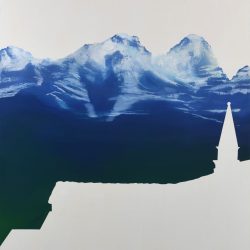
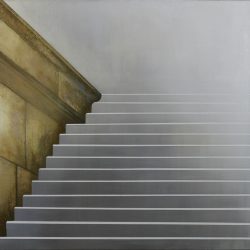
In Attila Kondor’s paintings, the city always appears within the landscape, viewed from above, where the interconnected silhouette of the buildings’ roofs defines the city’s character. The gaze finds solace in the majestic contours of the mountains rising in the distance above the man-made buildings and in the blue of the sky towering above the horizon. In the tense dialogue between nature and the built environment, the harmony of proportions and colors creates a balanced composition. The silhouettes of cities evoke specific places, but identifying them is rarely possible. The source of inspiration is most often Italy, where the creative power of culture and the majestic, awe-inspiring grandeur of nature appear simultaneously in the landscape. Kondor’s paintings, created using traditional Venetian painting techniques, speak simultaneously of longing and the limits of knowledge. Rising above the backdrop of everyday life and gazing into the distance evokes a longing to escape, while the homogeneous surfaces of the silhouettes bring to mind the blind spots of knowledge and the limitations of understanding.
The city, or city-state, was the most important driving force behind the spiritual and material development of Christian Europe, shaping the landscape in its own image through its physical reality. Its silhouette rises toward the sky in the landscape as a symbol of free thought. Kondor’s paintings draw just as much on his own experiences of Italy as on the topoi of European art history or the religious archetypes of our collective memory. The city, as an earthly reflection of the cosmic order, often shrouded in invisibility, nonetheless defines our daily lives. To perceive this, we must rise above the mundane and purify our vision. The silence in Kondor’s works clears the path for vision and, thus, for the possibilities of knowledge.
János Schneller, art historian, curator