In recent years, visual artist Zsuzsi Simon has explored expectations, taboos, and stereotypes related to gender roles. She often uses her own body and experiences as a medium, thereby directly and sensitively linking personal and social issues. A hallmark of her feminist approach is her view that the female body is both an experiential and a political space.
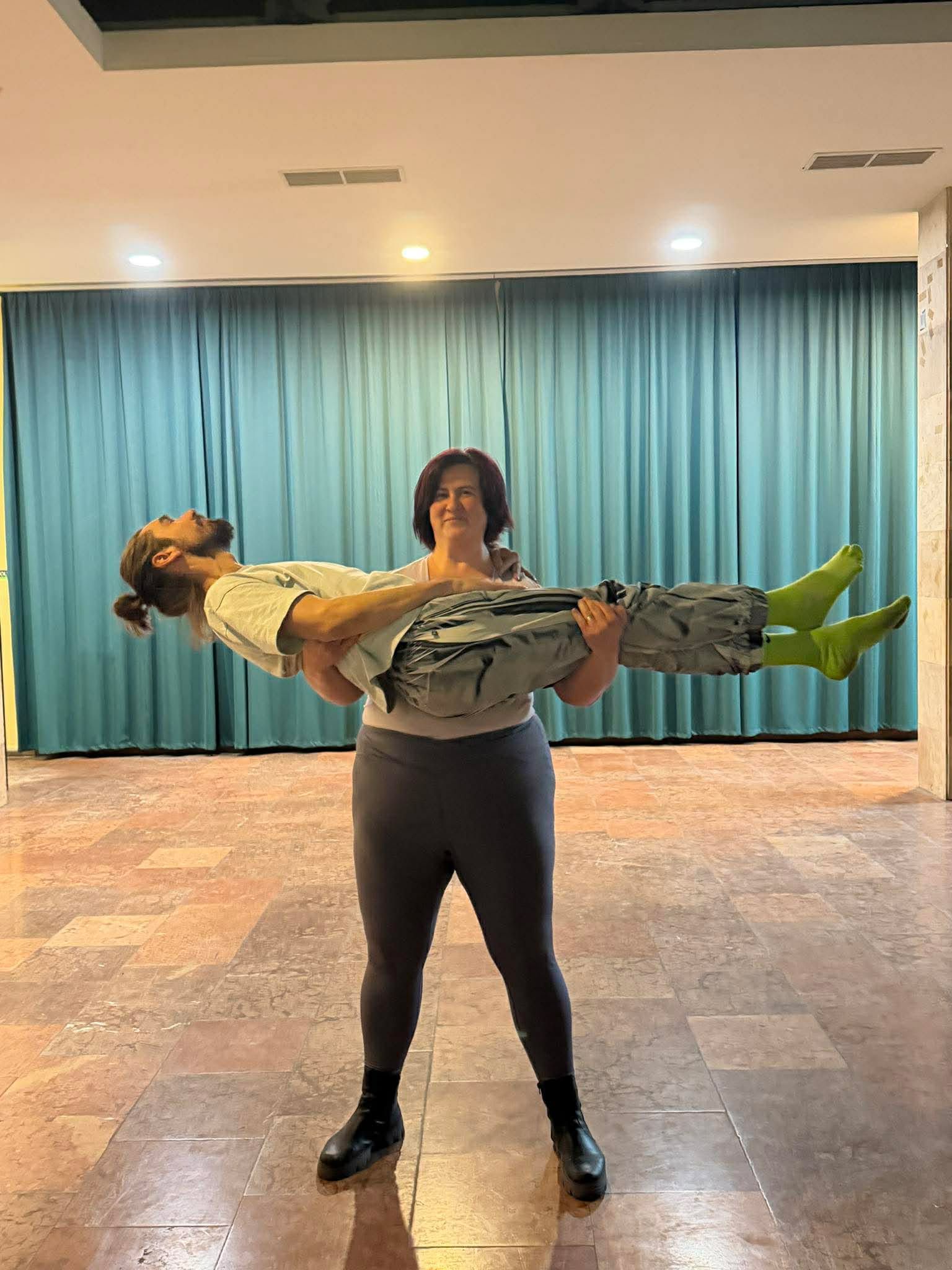
Her new works focus on female strength, which manifests not only in the life of the individual but also in the functioning of contemporary women’s communities. She invited women who are active athletes and aware of their strength to collaborate, so that through movement they could jointly explore the possible manifestations of strength in everyday, conflict-ridden, tense, or even traumatic situations. Experiencing the body—through the demonstration or reenactment of various gymnastic exercises—serves as an artistic method that opens the way to exploring contemporary meanings of “female strength.”
The project raises questions that focus on the interrelationships between gender, the body, representation, and power. What is the relationship between the images of muscular, sexy “superwomen” conveyed by visual culture and everyday reality? How can anger—labeled as destructive and irrational—be transformed into liberating energy capable of reshaping social relations? And what do strength and letting go mean in undervalued areas such as care work, housework, or self-care?
The visual world of the works consciously reflects on the historical traditions of physical culture, such as the emergence of female strongwomen in 19th-century circuses, gymnastics displays expressing community unity, lifestyle books, and the aerobics movement of the 1980s. While the photographs and videos evoke the aesthetics of these phenomena, the exercises created and performed together also shed light on normative and exclusionary mechanisms.
In the context of the exhibition, female power is thus not a stable, essential category, but a culturally and historically evolving concept that emerges through the continuous renegotiation of norms and expectations. As for the female experience, it does not necessarily manifest itself in spectacular physical performance, competition, or violence, but rather becomes perceptible in perseverance, determination, resilience, anger, and the maintenance of community—which also includes the conscious acceptance of letting go or vulnerability.