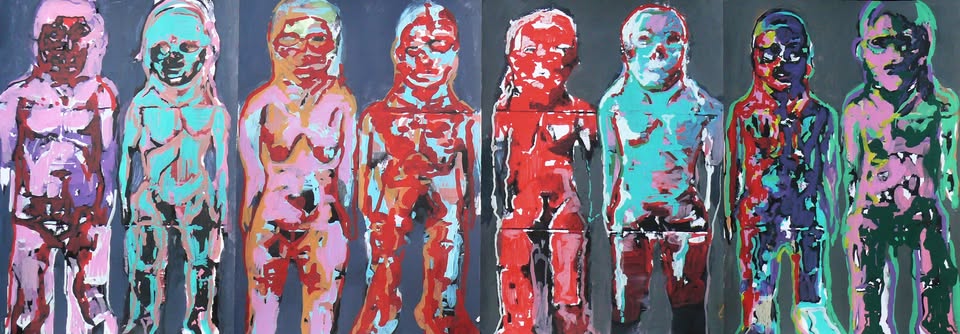
For decades, József Gaál has focused on representability as a painterly approach that pushes the boundaries of construction and deconstruction. Whether his starting point is existential, anthropological, theological, mythological, or metapolitical, the morphology of his body of work—which appears as various sequences and series—always returns to the same place: the human being, its cosmic determinism, the unnoticed devaluation of human essence, human materiality—that is, the ultimate materialization of the abstract.
Since the late 1980s, József Gaál’s painting has been driven by the immanence of figuration: drawing on the ancient archetypes of the creaturely, the erotic, the mystical, and the lyrical grotesque, it transforms through the gestures of distortion and hybridization into a material, layered, and coherent pictorial universe. Corpus Hystericum, Homo Homicida, Homo Inhumanus, and then Idolum have made the transcendence of humanity—arising from the universal human—the defining feature of the physical-ritual relationships created in the images. Common to their depictions is an archaic sense of identity, which, by overturning the dominant order of the image—more precisely, by shattering and then reconstructing it—creates a radically novel visual language.
The masked, distorted monstrosities, believed to be creatures sometimes lost, sometimes constructed from human material, appear as timeless beings. Gaál reveals the body fragments associated with the faces through the sensuality of details hidden in the texture, and all of this is present as a kind of condensed physiognomic concentrate within the conceptual field related to gender, the individual, or cultural discourses. Gaál’s representation of the face and body thus deliberately examines the essential human and inhuman; in this way, his painting is simultaneously a sensual and materialist art, which instinctively refuses to extricate itself from the pull of spiritual forces.
In his latest series, Pseudohuman, the dialectic between science elevated to the status of an idol (Idolum) and the law is placed within the tension of a unified visual narrative, where systems purported to be objective and the fallibility of the highest order of interpretation are underpinned by a scientific mindset that has become a matter of faith. Gaál describes the source of the inevitability of civilizational cataclysm as a false notion equivalent to the active controlling role of repression.
The personifications of this are prosthetic creatures that, by virtue of their birth, transform from autonomous beings into unidentifiable entities; they are metaphors for a struggle doomed to failure, manipulated entities assembled by external social constraints and the totalizing logic of technocratic beliefs. Their true Creator is a techno-feudal world based on a new theology devoid of theory, centered on a pseudo-human being born as an imitation of production and denying the classical concept of life.
In József Gaál’s new works, the marks emerging from the patchwork systems — sometimes giving the impression of loose, self-writing gestures, sometimes fragmented, disintegrating material-like layers — as well as the morphological representations of a subversively motivated shift in dimension, articulate themselves as acts of revelation and, through these overstretched bodies, become the revealers of a new, unshakable truth — or state of the world.
QUASI MANIFESTO
Without limit, every possibility we can imagine—must be realized. We have already elevated science to an absolute; before science, there are no natural laws; science is the law. In the name of science, there is no longer any need to invoke anything; scientificity itself is the faith. Nothing can be questioned; you can do anything in the name of science, in the name of Idolum. What you actually do in the name of science no longer matters at all; consumption is not a compulsion, the pleasure-seeking society is no longer enough — we do not offer a universe of permanent ecstasy, but have already instilled it within you. Who would dare to ask whether it is permissible to do everything you are capable of doing? The more important question is: what else can be realized? Let the new faith of the Absolute of Science, leading to the infinite, guide you!
All of this is just technique, technology — the Techno Idol Babel Bubbles that fuel consumption. Science has no direction, because faith is human arrogance. Science becomes production technology. Production technology is the sole goal. The essence of techno-feudalism is technocratic faith, the imitation of creation beyond the assembly of pseudo-humans. With this, doomed to loss and failure, the many prosthetic beings, through their lack, summon the true Creator.