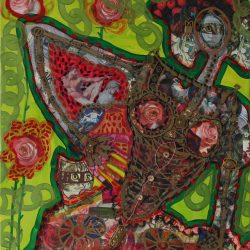
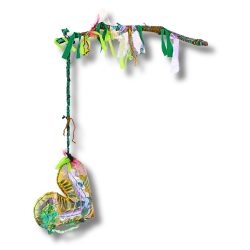
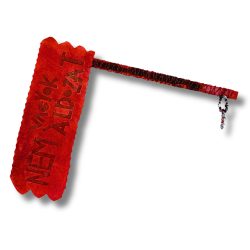
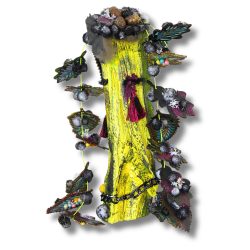
“Retentive Behavior” is a continuously documented diary of visual thinking installed within an intimate SPACE. Its starting point is that particular corner of a room, immaculate white in color, which serves not only as a physical location but also gradually comes to life as an inner space through the unique objects placed within it. It has become a sustaining, stable point where one can linger, connecting with the created object that appears at the junction of the white walls. In this sense, the corner serves simultaneously as a boundary, a refuge—both defining and sustaining.
What does it mean to HOLD onto something… a feeling, a state, a memory, or even ourselves in a vibrant world? Compositions made of freely assembled objects can provide time and space for these questions, delicately balancing the experience of permanence and transformation as sensations. The space is imbued with a different quality time and again: at times it becomes an altar, at others it appears as a kind of inner support, where the fragile elements nevertheless remain intact, radiating a peculiar unity, becoming, if you will, supports for one another.
The MATERIALS appearing in the installation’s components—paper, textiles, plastics, found and sculpted objects—together create a sensitive system. Beyond their individual meanings, their relationships to one another also strongly reflect the presence of the objects situated nearby. Retention here is not a static state, but an active presence: a kind of attention capable of remaining with what is currently taking shape… The works do not tell linear stories, but offer ‘COLORFUL’ states—starting from the blue zone, through the greenish-pinkish terrain, to the arrival in the red chamber, and then to the golden conclusion.
The sustaining attitude is both personal and universally applicable. It stems from individual experience, yet connects to such fundamental human QUESTIONS (referring back to the earlier points) as security, the practice of presence, and the possibilities of connection. The objects suspended here and there—half-seeking the safety of the walls, yet longing to soar through the air—are, so to speak, actively silent: they open up space for attention from the inside out and invite the viewer to perhaps recognize their own inner points of holding.