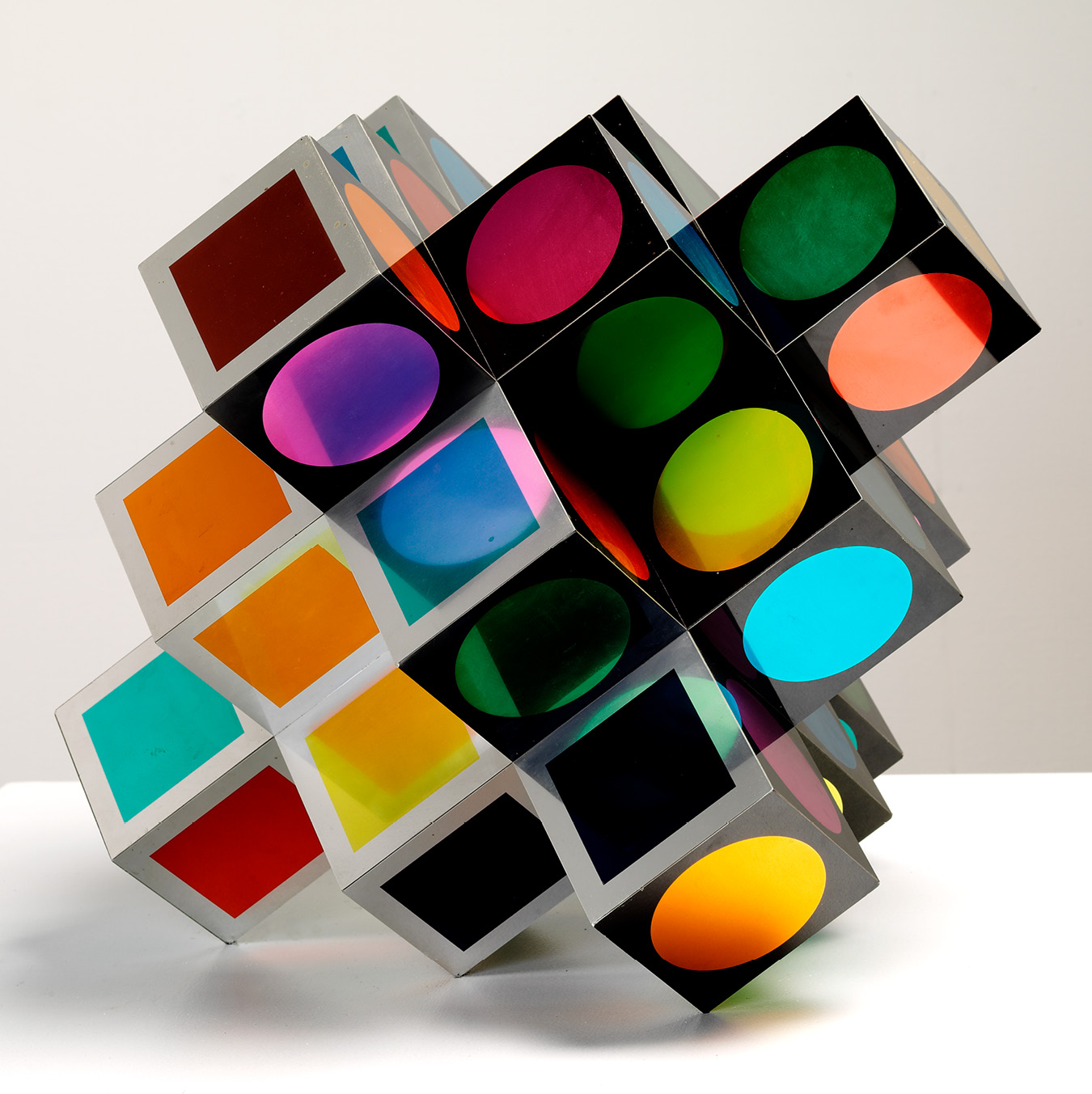
To mark the 120th anniversary of Victor Vasarely’s birth, we are presenting a major retrospective exhibition showcasing the life’s work of this artist of Hungarian origin who achieved worldwide fame in France. A significant portion of the exhibited works comes from the collections of the Vasarely Museums in Budapest and Pécs, supplemented by loans from the Fondation Vasarely in Aix-en-Provence. This collection of well-known works, many of which have never been seen in Hungary before, allows visitors to gain a comprehensive understanding of Vasarely’s art.
Vasarely’s oeuvre is linked both to his Hungarian roots and to international kinetic and Op Art. His work sparked one of the most significant shifts in 20th-century visual thinking: he played a defining role in the development of postwar geometric abstraction and continues to shape our thinking about visual culture to this day.
The last exhibition of this scale featuring Vasarely’s works in Hungary took place nearly 60 years ago, in 1969, at the Műcsarnok. The more than 140 works on display are accompanied by documents, as well as previously unknown photographs and films, which present Vasarely’s oeuvre with a comprehensiveness unprecedented in the history of exhibitions in Hungary.
The exhibition follows the major creative periods of Vasarely’s career in chronological order: from his early figurative experiments through the refined systems of geometric abstraction to the conscious composition of optical phenomena. The works on display convey the consistently evolving intellectual arc in which form, color, and movement.