“Budapest was in flames when I left in 1956, at the age of fifteen and a half. I made the journey alone through Austria and Germany to the United States, and by the time I turned sixteen, I was already in New York. János Kádár’s government outlawed the 1956 emigrants and banned their return for years. During this time, through a difficult and lengthy process, I learned to become part of this new world; I worked, I studied, and I became a strong, self-aware person in my own right. An artist.
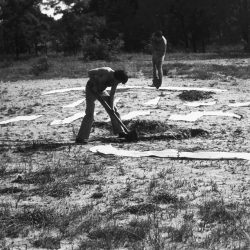
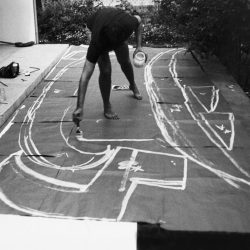
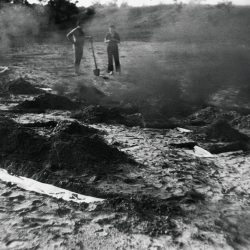
I returned for the first time in 1968, when the amnesty lifted the ban. The atmosphere was oppressive for someone who had lived in an open society. I was overcome by an overwhelming sense of claustrophobia. I transformed this into a work of art; into a performance.
I created my first conceptual work in Hungary.”
George Peck wrote these sentences in 1968 following his visit to Budapest. He continued to build his artistic career in New York, and he frequently returned to Hungary later on, though for a long time primarily just to visit family. Then, in 1995, he introduced himself to the Hungarian public with an exhibition titled “Complex Images.” In 2002, his exhibition titled “Layers of Time, Layers of Paint” opened in the Church Hall of the Kiscelli Museum, and in the same year he participated in the group exhibition “The Independent Life of Color” at the Műcsarnok; then in 2005, his exhibition titled “Paintings in Motion” opened at the Ernst Museum.
In 2016, his 1968 nature art photo performance was featured in the exhibition *Branches – Nature Art – Variations* at the Kunsthalle.
In 2026, George Peck visited Hungary for the first time since the pandemic, and he came up with the idea of presenting the project’s complete material and commissioning a publication. The exhibition is hosted by the MissionArt Gallery, where, in addition to the photographs taken in 1968, a white, monochrome painting created in 1977 will also be on display.
The exhibition’s title—From WHITE to BLACK, From BLACK to WHITE—not only refers to the project but also expresses a sense of life and a historical moment. The 1956 Revolution completely changed the course of young Peck’s life, and when he was able to return to Hungary 12 years later, he was shocked by what his former homeland had become. While preparing the exhibition, it was impossible to know what the future would bring, but it seems the prophetic power of art has prevailed; in 2026, we want to start anew with a clean slate, to redesign Hungarian history so that we may journey from black to white.