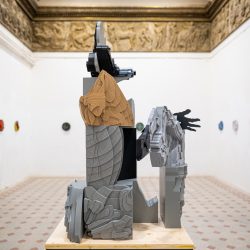
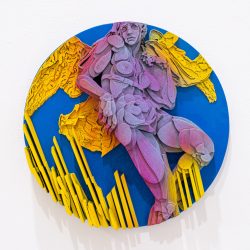
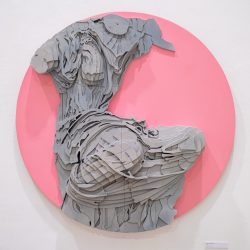
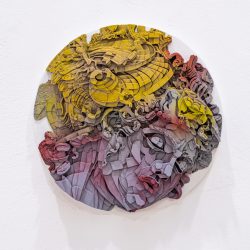
Zsolt Ecsedi’s sculptural practice occupies the transitional space between classical sculptural tradition and digital technology. His series titled *Flashback* represents an artistic stance that simultaneously reflects on art-historical memory and contemporary technological media.
The tondo format—an iconic compositional type in painting and sculpture used since the Renaissance—that forms the basis of the series is enriched with a new layer of meaning in Ecsedi’s works. On the one hand, the circular form refers to the classical artistic tradition; on the other, it creates a kind of enclosed visual space where fragments of the past and the technical tools of the present converge. At the same time, the circle has become a defining element in contemporary visual culture as a pictorial frame: the format of profile pictures used on digital platforms, particularly on social media, also follows this circular structure. Ecsedi’s works thus reactivate a visual form that simultaneously carries art-historical meaning and the familiar visual framework of today’s digital communication platforms.
The starting point for the works is often a prominent detail from a well-known sculpture. However, Ecsedi does not reproduce these forms; instead, he fragments, recodes, and digitally reconstructs them. Through the process of digital drawing and three-dimensional modeling, details of classical compositions gradually transform into abstract structures in which the figurative origin remains present only as a hidden reference.
The technological language of 3D printing—particularly the structure of the layered surface—becomes an important formal element of the works. The layering resulting from the printing process is not merely a technical byproduct, but a visual sign that becomes a conceptual part of the work: an imprint of the transition between digital imaging and the material object. The surface thus also carries a kind of temporal layer, making the art-historical references of the past and the technological mediation of the present perceptible simultaneously.
In Ecsedi’s works, the viewer’s perception also plays a key role. At first glance, the sculptures appear as abstract structures, but as the viewer’s attention deepens, classical figurative forms can gradually be discovered within them. This perceptual play activates a slow, exploratory gaze in contrast to the rapid consumption of contemporary visual culture.
The Flashback series is thus not merely a technological experiment, but a contemporary reinterpretation of art-historical memory. Fragments of classical sculpture are placed in a new context through the mediation of the digital model and the 3D-printed object: the iconic forms of the past appear in the visual language of the present, while retaining their art-historical referentiality.
In this sense, Zsolt Ecsedi’s works explore one of the key questions in contemporary sculpture: how can traditional sculptural thinking be transformed in the age of digital technologies? The Flashback series answers this question through a layered, media-based, and temporal dialogue in which the memory of classical sculpture and the tools of digital form-making reinforce one another to create new visual meanings.