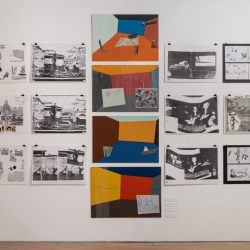

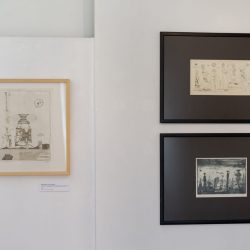
The exhibition now opening at the Miskolc Gallery is the first retrospective of the artist, who celebrated his 80th birthday last year. Imre Szemethy’s career took off in the early 1970s, following the death of Béla Kondor, during a period that marked the golden age of Hungarian printmaking. His early works are meticulously crafted etchings rich in detail, which delicately balance scientific description and abstraction, narrative and enumeration.
In the first decade of his career, he undertook nothing less than the “translation” of outstanding works of Hungarian and world literature into his own visual language. This series began with his cycle based on James Joyce’s *Ulysses*, followed by his illustrations of Hungarian ballads; in 1974, he presented his ambitious *Szigetvári veszedelem* series to the public. The final chapter of his literary series was a cycle of illustrations based on Miklós Szentkuthy’s *The Breviary of Saint Orpheus*. The motifs he developed in the 1980s lived on as unique hand-drawn illustrations in his *Dermoid* series.
Among his numerous book illustrations, the drawings he created for *The Songs of Maldoror*, Borges’s short stories, and Boris Vian’s narratives have achieved cult status. By this time, he was increasingly fascinated by Alfred Jarry’s absurd, pataphysical world, in connection with which he created surrealist collages and experimental animated and video films. The exhibition offers a glimpse into every phase of this ambitious career, confirming that Imre Szemethy’s style-defining body of graphic work ranks him among the outstanding figures of Hungarian neo-surrealism.
Emese Révész