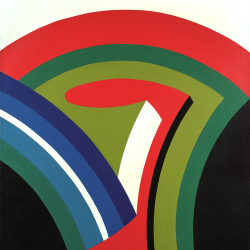

According to the principles of optics, the way colors work is pure physics. But in reality, they evoke eras, memories, and stories like a nostalgic madeleine. Socialism lives on in our memory as an economy of scarcity characterized by drab hues, and faded photographs do nothing to help this perception. K2’s opening exhibition sets out in search of these lost colors and attempts to reconstruct vivid color experiences from the visual arts of the past seventy years. The story begins in the early Kádár era, when Béla Kondor and Jenő Barcsay rediscovered the gold of icons, and then continues with members of the IPARTERV generation, who revolutionarily modernized the color spectrum in the 1960s.
New paints appeared on the horizon — Western brands and synthetic mixtures—slowly spreading to this side of the Iron Curtain. Ilona Keserü’s French tube-based red even forced the police to retreat, while artists at the IPARTERV exhibitions — such as István Nádler and Imre Bak—shocked the progressive audience with the new, modern color contrasts of acrylic paint and screen printing. Meanwhile, János Fajó attempted to adapt oil painting to homogeneous geometric fields. Thanks to new technologies, the color palette of the 1960s—at least in the field of fine art—underwent a significant transformation. One might have thought there were no more new bands on the color wheel, but the 1980s brought an explosion of UV-sensitive disco colors.
András Mengyán introduced fluorescent “neon colors” into geometric painting. At the far end of the spectrum, in the other invisible range, infrared photography emerged. This new way of seeing is represented by Gideon Horváth’s lightbox series. But technological developments did not end there: Gábor Kristóf hacked the powder paints of the RAL standards, Gábor Koós introduced high-tech ultra-blacks that absorb all light, and Andrea Sztojánovits captured the invisible by burning out the lens of her digital camera. Spanning seven decades, the K2 group exhibition presents the interconnections behind the birth of new colors, while outlining the technical and cultural-historical context.