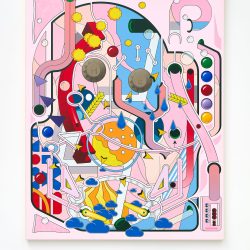
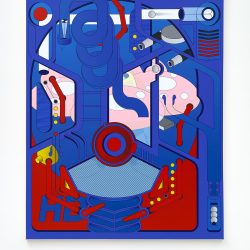
Ádám Varga’s latest series focuses on pinball machines, and more specifically on their visual dimension and the question of how they can be translated into two-dimensional form. The history of pinball can be traced back to the eighteenth-century French game of bagatelle, while the modern coin-operated pinball machine emerged in the first decades of the twentieth century. In 1947, the Gottlieb company’s Humpty Dumpty was the first machine to feature electromagnetically operated flippers. From this point on, players could not only launch or nudge the ball, but also directly intervene in its movement. The exhibited works emerge from this peculiar system. Each painting develops a distinct visual language, while a common structure and central question bind them together: how can a functioning system governed by rules be represented as an image?
In recent years, the problem of spatial representation has become increasingly important in his practice from a technical perspective. Combining plotter-based processes with painting, he creates flat surfaces that produce increasingly complex spatial experiences. The overlapping elements of the playfields, different systems of lines, transparencies, and occlusions create depth, as if the interior of an actual machine were revealed behind the surface of the canvas. The details of the pinball playfields can be traced with almost perfect precision. The possible trajectories of the ball, ramps, bumpers, flippers, tunnels, and other game elements appear not merely as recognisable motifs, but as parts of a functioning system, allowing us to mentally follow the path of the ball through the playfield.
The works in the series are defined by five distinctive colours: green, blue, pink, grey, and yellow. Colour studies play an important role in the artworks, and the individual paintings evoke different visual worlds: grey recalls the character of mechanical machinery, pink the visual language of toys and emojis, while green suggests the abstract structures of sports fields. Blue and yellow, meanwhile, can be understood as metaphors for colour scales. The gesture of appropriation characteristic of Varga’s practice also appears in these works. Among the details of the playfields, we encounter references to popular culture. Two characters from Pokémon are evoked, for example: Vileplume can be recognised against the background of the blue painting, while Jigglypuff appears in the pink one. Textual elements are incorporated into the paintings in a similar way. In the green version, the words “Greatland” and “sport” can be made out, while the yellow painting contains the words “hello” and “lock up.” At first glance, these motifs may appear to be hidden details, but on closer inspection they open up further layers of association. Each offers another point of entry, and the paintings can thus be continually broken down and reinterpreted, almost without end.
Ultimately, the exhibited works translate the tension between design and unpredictability, system and deviation, reproducible form and unique artwork into the language of painting. They do not simply depict a game; they become complex systems in which the eye, like a pinball, continuously searches for new and alternative paths.
Boglárka Tóth