The oeuvre of György Z. Gács (1914–1978) is one of the most consistent experiments in 20th-century Hungarian art in terms of how a work of art can become an active, perception-shaping element of the built environment. His career, which began in painting, became truly decisive when his attention turned to glass, light, and movement, i.e., the material and optical phenomena that became fundamental experiences of the modern urban experience. Z. Gács was active at a time when a wide range of artists believed in scientific and technological progress. In the decades following World War II, architecture relied on new materials such as concrete, steel, and glass, but these often created a cold, monotonous environment. The artist’s response to this was not rejection, but transformation, as he believed that building decoration should always be based on the main building material of the era. Glass became not a decorative accessory, but a tool for shaping space.
At the beginning of his career, he designed traditional lead-framed glass windows, then gradually moved on to autonomous glass sculptures. In the 1950s and 1960s, flat glass was the readily available material from which he was able to create a new kind of plasticity through layering, gluing, reflection, and the controlled use of light. The glass surfaces reflected and multiplied the view of the surroundings, so that the work functioned not as a closed form, but as a phenomenon existing in conjunction with the space.
In his mature period, the role of movement and light became decisive in the works of György Z. Gács. In his luminokinetic works, he created a moving visual experience by changing the rhythm and direction of light, while in his luminodynamic works, the interaction of light and matter created a constantly changing spectacle. His works thus built on the viewer’s movement and spatial perception. On the one hand, the viewer’s change of position created a constantly changing spectacle, and on the other hand, he also used real kinetic elements in a pioneering way. He was one of the first in Hungary to create motor-driven mobile sculptures in which glass, light, and movement reinforced each other to transform perception.
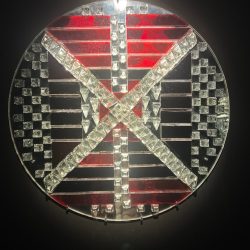
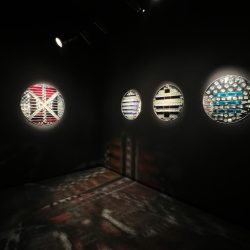
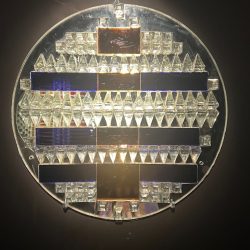
One outstanding example of this approach is the wall-mounted glass sculpture created in 1976 for the foyer of the Budapest Puppet Theater, which can be seen in the acb Bak Imre space. The large-scale, architectural work was created not as an independent object, but as an integral part of the space. Embossed and flat glass surfaces, different structures, and light sources combine to create a subtly pulsating, changing image. The composition is neither illustrative nor narrative: it does not depict the world of puppet theater performances, but rather transforms the time of waiting into a sensory experience. The work simultaneously directs the gaze and relieves the tension in the space, while organizing the optical effects into a playful yet disciplined order. Throughout his career, Z. Gács consistently maintained that the task of a work of art is not to abstract from reality, but to teach in new ways.
This exhibition presents details of the 1976 puppet theater glass sculpture, related elements, and its conceptual background. The works on display bear witness to the spirit of an era, the belief in progress, the importance of materials research, and the exceptional role of György Z. Gács, who, as both an educator and a creator, defined the direction of Hungarian glass art. His works still invite us to perceive space not as a static background, but as a constantly changing, living medium.