The landscape is never our home; we are always just guests in it. It is not closely connected to our living space, nor is it part of our existence from a practical point of view. We only really notice its presence when we leave the backdrop of everyday life behind and step out into the wilderness. The landscape is therefore an image of nature that we do not use in a practical sense. Unlike natural formations, the landscape only exists when someone observes it, that is, when someone creates it. As Schlegel writes: “The landscape as such exists only in the eyes of the observer.” Or Schelling: “…the landscape has reality only for the observer.”
Landscape is in fact always a vision constructed, cut out, and framed by the specific worldview of an era or society. We ourselves define the framework of the concept of landscape. The experience of landscape can therefore only ever be a relative concept, in which the relationship between nature and society, nature and culture, nature and human existence is constantly being weighed up. In this sense, landscape is both the revealing framework and the boundary of existence, teaching us not so much about “nature as a whole” as about the limitations, imperfection, and finitude of human will.
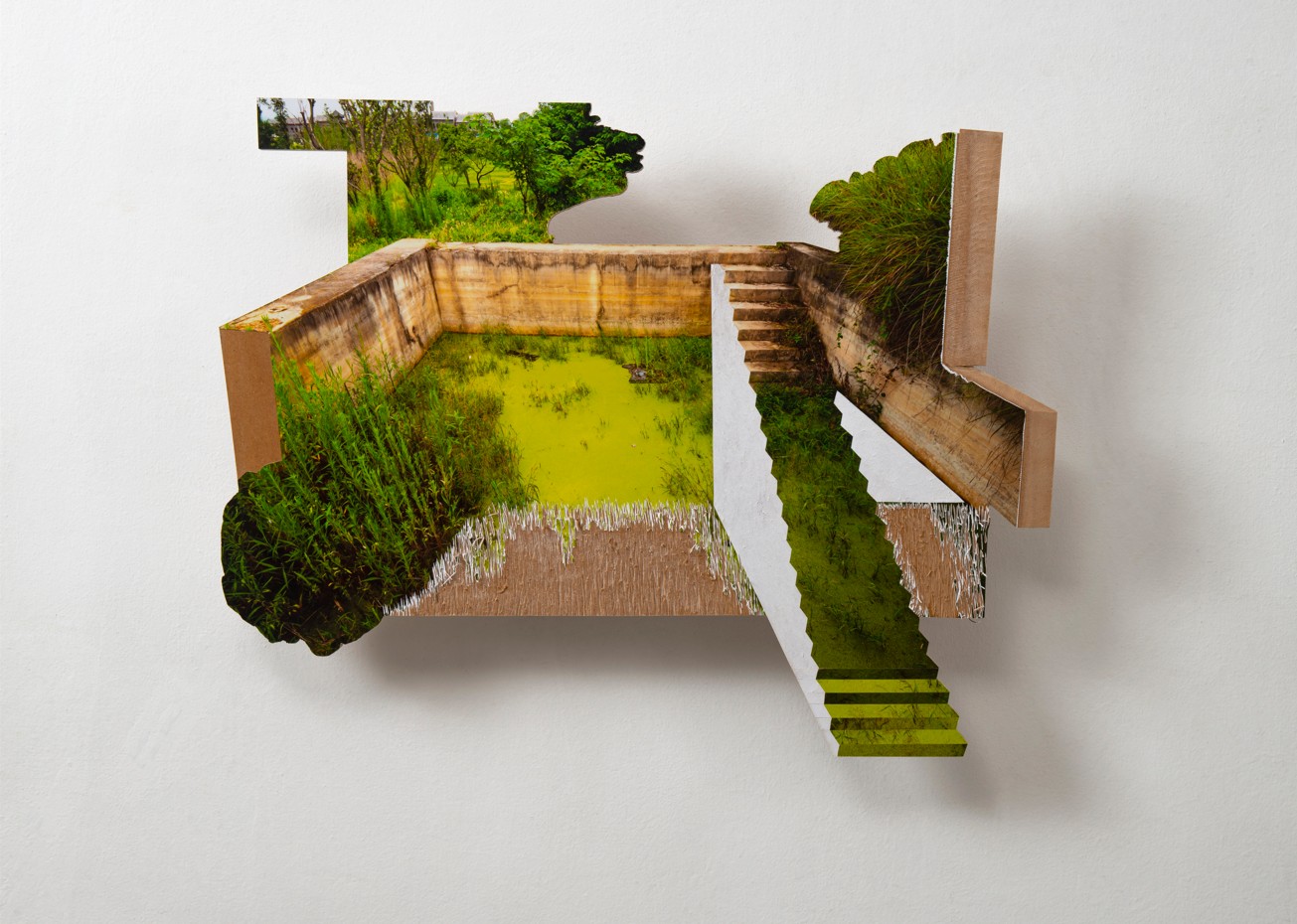
When we talk about the beauty and majesty of landscape, Martin Seel distinguishes between three different forms of perception: contemplative, corresponding, and imaginative landscape perception. This threefold division perhaps best reflects the fundamental character of Tibor Gyenis’s landscapes: where the contemplative element is a gently idealized setting, the corresponding element is the manipulative image form that oscillates between two and three dimensions, while the imaginative element is conveyed by destruction evoking anthropocene and post-anthropocene perspectives.
Gyenis’s works are not really images, but rather “only” quasi-images. Simultaneously utilizing two and three dimensions, it is difficult to determine how real they are and how much of them is genuine. They convey an intermedia experience that is closest to Jean Baudrillard’s concept of hyperreality. They are more like assemblages, where the artist manipulates the image with physical elements: he manually cuts out the terrain depicted in the photo and supplements the image with paint, thus transforming it into a strange model of the original landscape or built environment. Moreover, these models often depict some kind of event or process, such as the transformation, development, or decline of industrial and natural landscapes, through which the artist also outlines an anthropocene or post-anthropocene perspective.
This particular perspective, vision of the future, is particularly relevant in the current era of posthumanism and global ecology, whose theories most often suggest acceptance and abandonment. The acceptance of a new, “polluted,” degraded nature, and the irreparability of nature’s ideal state. The landscape is now nature in the presence of ecological catastrophe, in which humans must learn to live with their own ecological and even geological weight. “All of Gyenis’ quasi-images exude the spirit of the quasi-subject dissolving into nature and post-humanism, while oscillating between two and three dimensions, image and object, culture and nature.