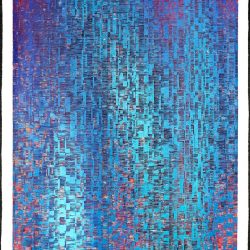
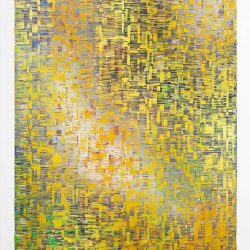
Our exhibition features a selection of works by Stefan Osnowski (1970) created mainly in the last few years, but also includes a few pieces from the artist’s earlier cycles, which are organically linked to the latest images in terms of both content and form. All of them take their starting point in nature, the landscape, and the flora surrounding us, and reflect on the ideas and attitudes associated with these. Osnowski’s works are difficult to categorize, as they are woodcuts in a technical sense, but their size and method of production are unique and unrepeatable, and thus bear much more resemblance to painting.
His latest works are based on a reductive process in which the artist continues to carve the printing block between the printing of each layer of color, making the image built up from layers on top of each other unique and unrepeatable: there is no way to correct or reproduce it. The artist creates his images by repeating and shifting grids and structures inspired by digital imagery. The compositions, sometimes consisting of six layers, contain the same number of colors, which can take months to dry on the surface of the handmade paper. During this lengthy process, the image develops intuitively, often surprising even the artist himself. This peculiar temporality of the images—the past, the present, and the future—is a phenomenon that particularly fascinates the artist. Similar to a palimpsest, Osnowski layers one layer on top of another without completely erasing the previous one.
Arcadia has played an important role in European art history as an ideal, paradisiacal landscape since Virgil. Later, from the 17th century onwards, it also appeared in painting, conveying the idea of a golden age that was not real for the viewer, but rather the harmony of a desired landscape. The paintings of Claude Lorrain and Nicolas Poussin are particularly exemplary in this regard. Their art defined the visual culture of their era to such an extent that art lovers on the Italian Grand Tour saw the Mediterranean landscape through their “eyeglasses.” Our contemporary way of seeing is defined primarily by idealized screensavers composed of pixels and displayed on the illuminated screens of smartphones, with their oversaturated colors. Osnowski reflects on this in his imagery by reviving an ancient technique, in which the landscape is broken down into pieces and reborn on the surface, obeying the laws of abstract form.
The abstract landscape constructions create optical noise and a kind of vibration, as if we were looking through a filter that tests and questions our perception. The artist avoids unambiguous motifs; the works are on the verge of decay, with amorphous vegetation barely recognizable as it splits and decomposes. The representational character is almost completely absent, as the images dissolve into abstract fields of color. The loss of a common narrative and the overlapping and partially erased fragments of stories create a spectacle in which the desired nature appears only in the form of bits. The titles that open up cosmic perspectives (Archernar, Nebula) also refer to the idealized spectacle of images of nebulae and galaxy clusters, which are just as much the product of human imagination as Claude’s Arcadia. In Osnowski’s woodcuts, however, fragmentation is much more pronounced. These are images of fragmented, scattered, partial knowledge, which are unable to piece together the vision of Arcadia, now completely disintegrated.
János Schneller