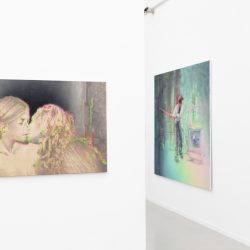
The title of the exhibition — which also serves as the title of one of Szűcs’s paintings — was inspired by a letter Vincent van Gogh wrote to his brother: “I am always in the hope to express the love of two lovers by a marriage of two complementary colors – colors which marry each other…”.
The duality of colours and visual elements, which complement each other and at the same time generate a vivid tension, permeates the entire exhibition. This dualism, the examination of synchronous phenomena in Szűcs’s practice, simultaneously alludes to harmony—or its impossibility—and to the complementary colours of the visual world.
In the painting Complementary Love, an intimate kissing scene is disrupted by green and red lines that evoke the phenomenon of digital noise, making this peaceful, idyllic moment suddenly appear as though seen through a damaged data file or a mediating technological device. As here, the depiction of fragmented reality and the appearance of digital glitches play a prominent role in Szűcs’s latest works.
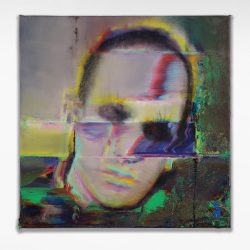
The figure of The Disappearing Singer or the portrait of Bergman seems to dissolve into space; their forms blur into pixels before finally disappearing into the ether. This image-glitch is not merely an aesthetic device but a trace of the transience of identity, memory, and presence, while Szűcs makes clear references to the world of cinema, particularly to creators known for their surreal atmospheres (David Lynch, Ingmar Bergman).
His monumental work, Escape appears at first glance to be a mesmerizing landscape washed in pastel colours. On closer inspection, however, it becomes more haunting: a group of people fleeing from reality into the digital world — or perhaps from it — searches for a new place somewhere beyond the field of the visible. This work, like the other paintings in the exhibition, is saturated with secrets and tension. The pair of pistols facing one another, a hand reaching into a pocket, the mysterious female figure waiting behind a curtain and hidden beneath a cascade of hair, or the spontaneous shift of recognizable visual elements into abstraction — all evoke a moment torn out of space and time, and its inherent elusiveness.
Szűcs’s most recent paintings present a coherent, forceful painterly universe. Using the classical language of painting, they probe some of the most pressing questions of our contemporary world, examining the relations and tensions between analogue and digital, presence and disappearance, the human and the technologically mediated.