Born in Komárom, Hungary, to a Jewish family, he studied in his hometown, then in Budapest, Berlin, and Prague. Around 1928–29, he was already working in Paris, considered the capital of art, where he eventually settled in 1934. He came into contact with the Surrealists and the artists of the École de Paris at an early age, and his art was shaped by these two influences before the war. In 1937, he participated in the creation of a monumental fresco for the Palais de l’Air pavilion at the Paris World’s Fair, led by Sonia Delaunay.
During the war, he served for six years in the Czechoslovak army in France and then in England, where he created the graphic series Civilisation and Star of David, which deal with the horrors of war and the suffering of the Jews, presenting human suffering and vulnerability with elemental force. Géza Szóbel’s entire family remained in Komárom and became victims of the Holocaust in 1944, and the artist never returned to his homeland after 1945.
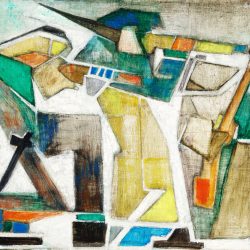
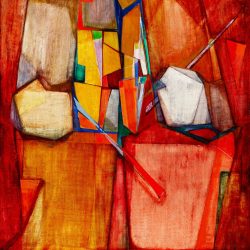
His paintings, which employ a unique glazing technique full of light, became more colorful, open, and increasingly abstract after the war. His figures—warrior angels, shapes reminiscent of children’s drawings, compositions reminiscent of Gothic stained glass windows—are part of an ancient and mystical world where man has not yet been fully born. Géza Szóbel’s fundamentally melancholic visual world became increasingly abstract, relaxed, and dynamic from the mid-1950s onwards. However, his life was cut short; his last solo exhibition in Paris was still open when he died in the summer of 1963 at the age of 58.
However, after his death, the life and artistic legacy of painter Géza Szóbel, like that of many émigré artists of the second École de Paris, fell into almost complete oblivion. His works were scattered in the 1970s, and his oeuvre fell completely outside the scope of art history. Szóbel, a multi-ethnic artist and cosmopolitan who considered all of Europe his home, ultimately received no recognition in any of his countries of origin. It was only in the 2000s that art dealers began to take notice of his works. The aim of this exhibition is to reconstruct the chronology of his life, locate his scattered works, and present one of the most promising, exciting, yet forgotten oeuvres of French modernism in a museum setting.
The exhibition is a joint collaboration between the Ferenczy Museum Center and the Kálmán Makláry Fine Arts Gallery.