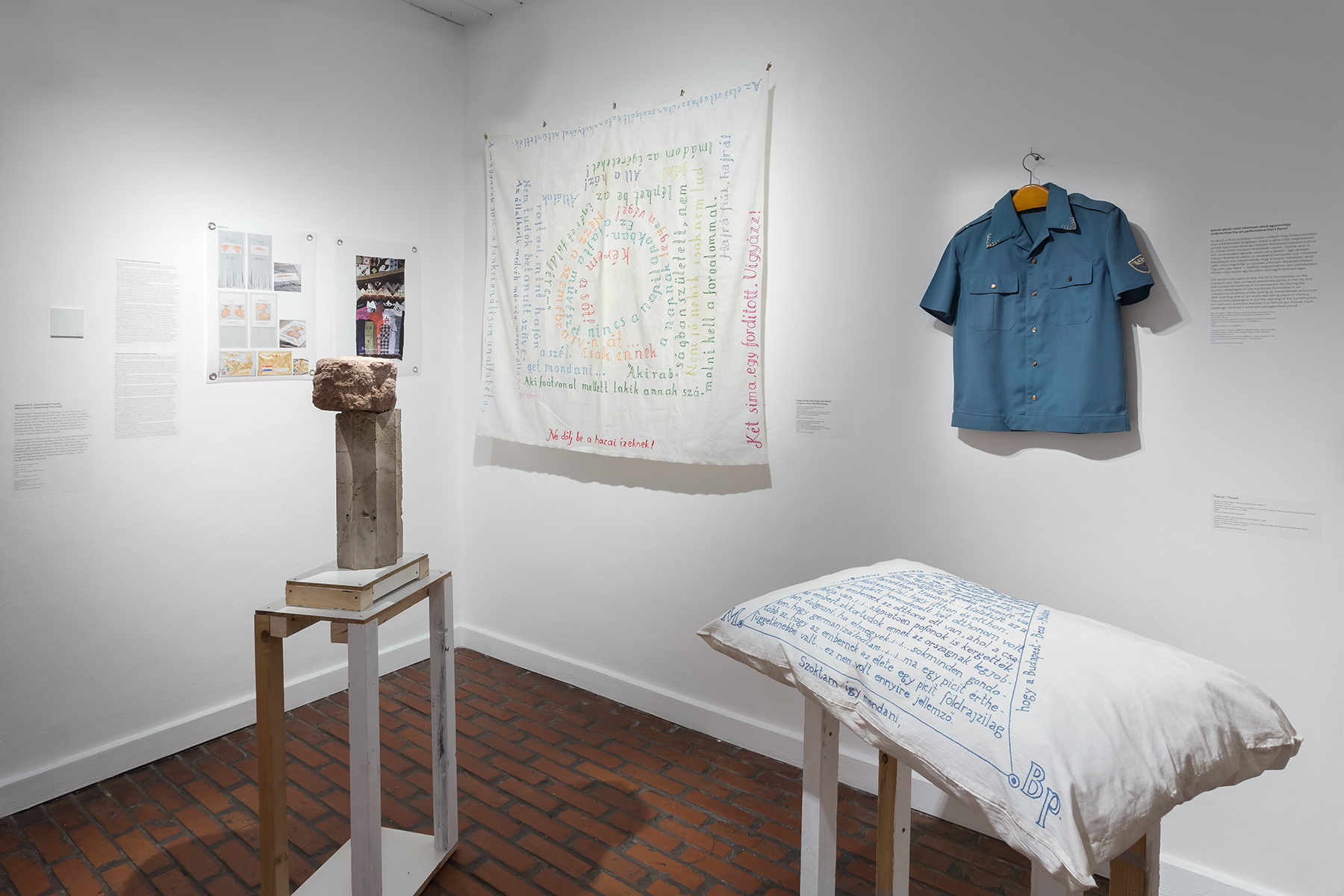
The mission of the exhibition HINTS Institute for Public Art is to contribute to mapping the history of public art that took place in Hungary in the 2000s, to question its traditions and conception of art, with particular regard to the presence and role of women in shaping urban public spaces. The narrative of this history is far from coherently explored and documented. Therefore, the exhibition attempts to supplement this narrative with new elements by reorganising and making visible partially forgotten knowledge and memories, emphasising the significance of the recognition that historical foundations and the knowledge of past artistic practices are indispensable for understanding the connection between art and public spaces in the present day.
The exhibition focuses on the work of the HINTS Institute for Public Art, an art collective composed largely of women active in Budapest between 2001 and 2010. Our exploration takes place through them, with their help. The fragmentariness of available information about HINTS is symptomatic in itself, insofar as it can be interpreted not only as a practical deficiency, but also as the structural inadequacy of knowledge production, archiving, and canonisation. All of these problems may stem from the rudimentary quality of technological infrastructure in the 2000s, from the lack of the imperative of archival, from the inability to institutionalise, from the very nature of public art projects, and from the social structure in which male artists are more supported.
The membership of HINTS is composed of visual artists and sociologists: Mónika Bálint, Tamás Ilauszky, Zsuszanna Rebeka Pál, Eszter Ágnes Szabó (1966-2024), and Anikó Szövényi. In 2000s Hungary, they proved to be pioneers in promoting the quotidian nature and accessibility of visual arts by venturing outside the walls of institutions and entering the public space. Their activities were largely influenced by the Situationist movement, which had liberated public space from capitalist control with revolutionary creativity, by critical cultural studies, and, especially in the second half of their praxis, by the ideas and creative tools of Eszter Ágnes Szabó.
Their basic principles included recycling, playfulness, criticality, communality, and participation. Some of their works gave rise to an alternative public sphere or proposed alternative ways of entering the public sphere, while other projects highlighted certain phenomena in the social environment through the engagement of those affected. They also sought to challenge the relationship of individuals to private and public spaces, to motivate the communities forming in these spaces, and to dissolve the boundaries entrenched between different spaces.