
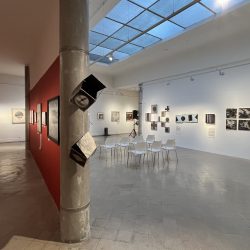
It is a great honor to speak here. I am not knowledgeable about art, including photography. However, I really like Minyó’s work, and I have been following him since we met through mutual friends a few years ago.
Minyó gave his exhibition a beautiful, elegant title: FoToNoIrE phenomena: non-linear dynamics. The name Minyó gave to the picture on the invitation is Somersault. With my short introduction, I would like to refer to the fact that by turning the world upside down, we see the world upside down here.
One of the most prominent representatives of modern neurobiological thinking is Nobel Prize winner Eric Kandel, who received his award in the United States. By analyzing the neural connections of snails, he discovered the mechanisms of learning. This is why he received the Nobel Prize, but he was actually a persecuted Viennese Jew who fled after the Anschluss when he was in high school, and when he became a Nobel laureate, he was able to return to his loves and wrote a beautiful book about Viennese art at the turn of the century and what he believes to be the driving force behind modern art. A Nobel Prize winner can afford to write a decorative book about his hobby. As an amateur, he was given the pictures, and he presents his thoughts on art in a series of beautiful images. Kandel’s starting point is that modern painting fell into crisis at the beginning of the 20th century because of the advent of photography. The world of photography spelled the end of former realist and impressionist painting because, painters thought, photographers were better at reproducing reality. The reproduction of reality as an artistic program is not possible. The whole deconstructionist type of art, and on the other hand, the conceptual type of art, all came about because of the challenge posed by photography, says Kandel.
Why am I saying this at an exhibition like this? Minyo’s work, because what we see here is indeed a body of work, shows that the opposite is also true. Minyo looks at what we can do independently as artists with photography. Starting from the photograph, we once again experience how humans construct the relationship between the image and reality, and the experimental disruption of this constructed relationship is art, in this case art that experiments with photography.
Minyó’s experiments, because he actually experiments with the material, constantly make us think again about how an image is constructed from a point, the experience of which is shown in numerous images here in the exhibition. Playing with Suprematism, the images offer beautiful and exciting games. In many ways, they resemble Malevich, Rodchenko, and in certain respects, Mondrian as well.
In the exhibition, next to a red wall, Minyó also shows in a series of shadow images that playing with photographic technology not only contributes greatly to our understanding of vision, but also to our understanding of human relationships. Through the shadow images, the dynamics of faces and people make the viewer realize how complex human relationships are built from minimal features.
It seems complicated, but here we are shown in a playful way how images are created from the play of light, and how images give us the impression that we are seeing a surface, an object, while on the other hand, how images create human relationships and human dynamics. This game is what makes Minyó’s exhibition so exciting, and I sincerely hope that it will make not only those present here, but also those who visit the museum over the next few months, think again about their relationships and how the world works.
Csaba Pléh