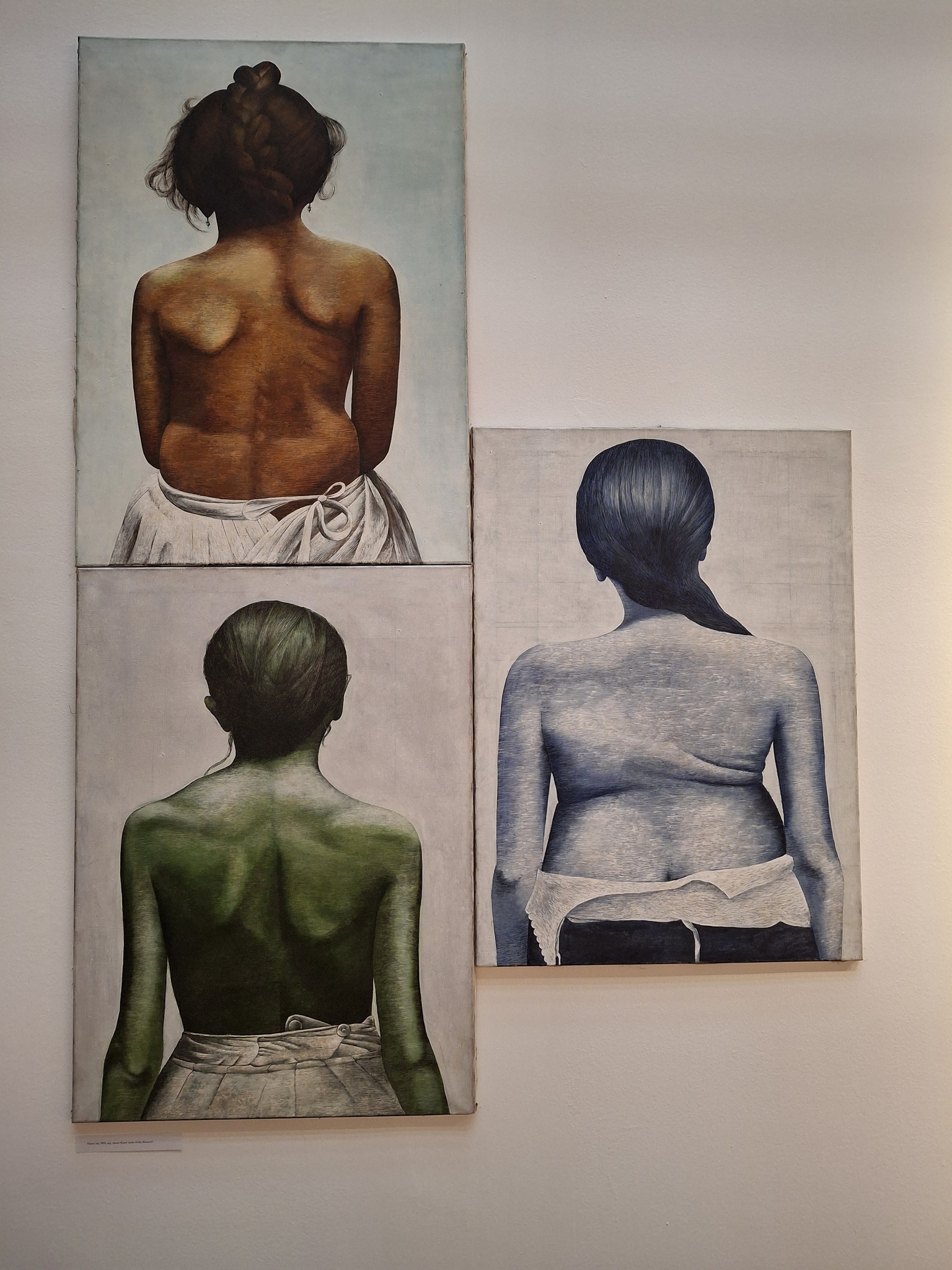
Frigyes Kőnig was born in Székesfehérvár in 1955; he has close ties to both the city and the museum. His initial inspiration came from his family and the city, and his art teacher was the painter István M. Tóth. Later, his career was guided by such emblematic archaeologists and art historians as Jenő Fitz, Márta Kovalovszky, and Péter Kovács. After completing his college studies, he was the first to win the Smohay Foundation scholarship, and his first large-scale solo exhibition opened at the museum in 1985. He had previously exhibited his works and painting cycles, which touched on topics, genres, and issues that were of current interest to him, eight times in Székesfehérvár. Significant pieces of his oeuvre are preserved in the King Saint Stephen Museum. One of the major works of contemporary Hungarian ecclesiastical art, one of Kőnig’s masterpieces, can also be seen in the city: the monumental mural designed and executed for St. Stephen’s Cathedral in 2022.
Frigyes Kőnig has been teaching at the Hungarian University of Fine Arts’ Department of Art Anatomy, Drawing and Geometry at the Hungarian University of Fine Arts since 1990. He was rector of the university between 2005 and 2013 and has been chairman of the Doctoral Council since 2013. He has been rector emeritus of the university since 2025 and is currently a lecturer. His nearly fifty-year career as a creator, researcher, educator, and scholar has been marked by solo and group exhibitions, numerous publications, and public appearances.
The exhibition, which presents the trends of recent decades, aims to showcase the highlights of his oeuvre in as varied a form as possible. The museum and the artist’s archive are revealed, with photographs illustrating Frigyes Kőnig’s creative and living spaces, his works, exhibition openings, and the venues of gatherings with friends. While the photographs tell the story, the graphic folders reveal countless previously unseen and unpublished works. The digitization of his graphic material makes it possible to view his early drawings, sketches, anatomical, botanical, zoological, and castle drawings. Seven public and four private collections have loaned works of art for the exhibition, which is complemented by the artist’s own collection, which has been kept intact until now.