Imre Mariann uses everyday yet unusual props in her works, which often carry symbolic meaning and even sacred connotations. Her aim is usually to evoke the concepts of memory and passing away in a metaphorical, mysterious way. Perhaps it is not surprising, then, that Christian martyrdom, legends of saints, and the themes of religious holidays have repeatedly returned in her works.
In contrast to her exhibitions of recent years, which were constructed from small objects and nuanced details and guided viewers into diary-like worlds, her exhibition Capturing Transience: Body-Soul follows a somewhat different dramaturgy.
The works now on display are not based on the linear temporality of the soft, invisible routine of intertwined everyday life, but rather on the possibility of the end and the beginning inherent in the end, that is, the sacred experience of return, which is the leitmotif of his new works. These works are not memoir-like, nor are they a series of intertwined stitches. Instead of evoking passing with subtle, slow, and gentle transitions, the artist now attempts to evoke the rebirth inherent in transience through the device of circularity.
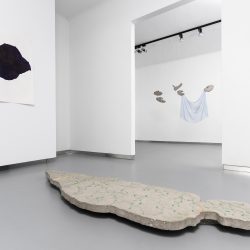
Of the two spatial installations presented in Szikra, the first is the already well-known Saint Cecilia (1996), which is a reinterpretation of Stefano Maderno’s marble sculpture of the same name (1599, Rome, S. Cecilia in Trastevere). This work, currently in the collection of the Hungarian National Gallery–Museum of Fine Arts, is the predecessor of the work of the same title, which was unfortunately damaged during its first public presentation. “The installation … is an ’embroidered’ concrete floor sculpture that combines the ‘properties’ and ‘functions’ of a tombstone embedded in the walking surface, a grave mound covered with grass and plants, and a carpet.
The pattern spread across its surface replicates organic ornamentation: leaves sprout from spreading green stems,” writes art historian László Százados about the piece, evoking the idea of death and rebirth. At the same time, the damage, the fractures visible on the legs and neck, add a new layer of meaning to the work. Most notably, they evoke a return from destruction, the character of resurrection, as the figure of Saint Cecilia represents brokenness (an attempt was made to behead her with a sword, but the execution was unsuccessful, and the executioner left the saint wounded) and immaculacy (the saint died a martyr’s death as a virgin, and her body was found completely intact in her tomb, opened in 1559, while the resting place exuded the scent of lilies and roses).
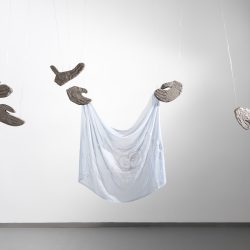
Similar to Saint Cecilia, the other spatial installation also takes its starting point from a classical work, located in Subiaco, in the crypt of the monastery built above the cave of Saint Benedict. One of the side groups of the mural depicting the crucifixion of Christ shows the Virgin Mary’s suffering beside the cross. The mother, collapsed in grief, is surrounded by seven figures in the fresco, painted in the well-known lyrical style of the 14th-century Sienese school.
Mariann Imre extracted and slightly reinterpreted the Mater Dolorosa scene from the depiction: she highlighted two motifs, the sorrowful virgin and the hands supporting her, from the composition and created a spatial installation from the reduced visual elements. In addition to extracting these elements, she also reinterpreted the original depiction. She replaced the central figure of Mary with an embroidered tulle veil, on which she embroidered an ultrasound image of a fetus from her own hair.
Similar to Saint Cecilia, the motif of return and its mystery also play a prominent role in this installation. And not only in the idea of resurrection, which is already present in the Stabat Mater: “When I must leave this place, / let me go to victory / through your mother, my Christ! / And when my body dies, grant / that my soul may receive / the paradise of palm trees!” But also in the intention to replace the figure of Mary with tulle bearing the image of the fetus, which results in a more concrete evocation of the cycle of life and a more direct evocation of the role of motherhood.
In addition to the two installations, several graphic works – drawings and watercolors – are also included in the new exhibition. The pencil drawings on display are all titled Body. The dried plants (cactus, beetroot, okra) on the sheets are delicate, sensual, natural evocations of passing, which, in light of which, the idea of return and its gentle mystery evoked in the spatial installations unfold before us as an even more sensual and profound aesthetic and philosophical experience.