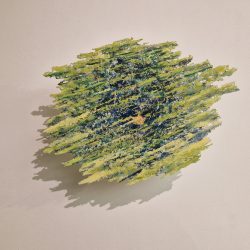
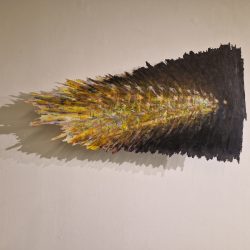
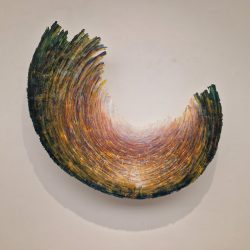
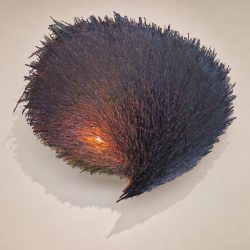
In societies that are free, more mobile, open to change, and integrate a wider range of knowledge, an artistic approach that works with asymmetries and more experimental, complex compositions may have been dominant in the arts. This makes my own painting somewhat easier to understand. It is clearly decodable that, living my life with open eyes, I carry within me both the psychologically understandable need for stability, eternal validity, and the symmetry that expresses it, and, in contrast, the symmetry-distorting, tension-creating effect of my dynamically changing world. I can no longer deny my simultaneous awareness of these insights.
For me, this denial would be cynical submission, a kind of lie, retrograde stubbornness, and, in my opinion, destruction of a potentially malleable, flourishing future. In my organically developing images, this unavoidable dynamism, experienced as a fundamental experience with philosophical meaning, inevitably breaks my initial tendency toward symmetry. My paintings reject the traditionally regular and symmetrical image formats with the same naturalness as they reject the ultimately monotonous, organically inherent characteristics of all panel paintings.
For me, all this became a question of honest insight into myself and the world, which also became one of the most important ethical dimensions of my art, if not the most important. Just as the outside world shamefully refutes my naive plans and ideas for balance and tranquility, so too do I constantly reject the static order and symmetry inherent in my images by experiencing and expressing this reality.
Bálint Miksa