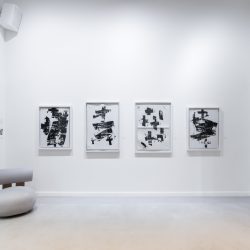
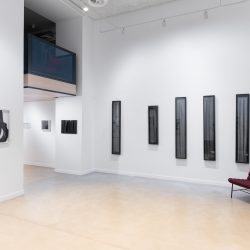
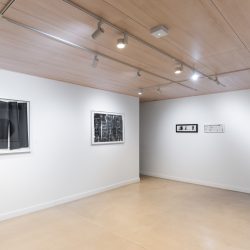
Zoltán Tölg-Molnár, artist and teacher, passed away a year and a half ago. However, our exhibition is not a retrospective, but rather a subjective selection from his oeuvre, composed not according to periods, but on the basis of visually related works. Works from the 1990s and 2000s are displayed alongside those from his final period.
What they have in common, however, is a minimalist approach that favors the color black. Black, which, if we wish, can be interpreted as the sum of all colors, the absence of light, or, if we place it in a cosmic perspective, even as absolute emptiness, as in the works of British artist Anish Kapoor. On the other hand, depending on the properties of the surface, it can also be interpreted as a reflective surface that returns light, so that the viewer perceives it as a shiny (white) surface. However, the artworks stand on their own as sensual creations, without any symbolic or secondary interpretation.
Tölg-Molnár did not create paintings, but rather pictorial objects. His art broke out of the confines of painting very early on, in the 1980s. Paint became just another material for him, like paper pulp, canvas, bitumen, foil, or metric screws—one of the many materials he uses in his works. In this sense, his works are not abstract paintings, but art objects that are much more taciturn than paintings due to their lack of tools, yet at the same time very concrete objects. They are images that are primarily what they are: damaged, split, or perfectly smooth sensual surfaces that create their own aesthetic quality, or language, if you will.
With his black images, Tölg-Molnár has created a visual world that, like the elements of language, can be learned, but not rationally, rather best through the senses. Their soft, matte, rough, broken, torn, and split surfaces directly affect the nerves that scan the eye, thus directly stirring, calming, or arousing our curiosity.
However, there are also much more direct manifestations of language in the exhibition space. In the 1990s, through learning German, letters, word combinations, and inflections actually appear in the images. Mostly as visual metaphors for remembering, forgetting, and reconnecting with European culture. At the same time, the fragmentary evocation and layering of existential phrases drawn with chalk on a blackboard and erased with a sponge confront the viewer with the passage of time.
The images simultaneously convey stuttering, mistakes, the search for the ultimate, perfect form and the futility of attempts to achieve it, as well as signs of woundedness. Just as Günther Uecker, a German visual artist, expressed vulnerability and woundedness through embossing and piercing, Tölg-Molnár expresses it through tearing and ripping, piercing and embossing the surface of the image.
Zoltán Tölg-Molnár was a legendary figure both as a teacher and as a person. He taught at the Secondary School of Fine Arts from 1972 to 1987 and at the College of Fine Arts from 1987 onwards, where he had a great influence on several generations of artists, but he also learned a lot from his students. Over time, his art, like negative theology, makes fewer and fewer statements, taking more and more away from the work until there is nothing left to take away, thus creating an image that requires true silence to speak, and time for the viewer to relearn the melody of the forgotten language.
János Schneller