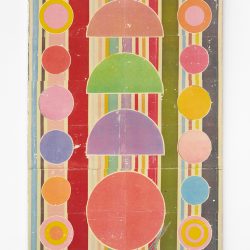
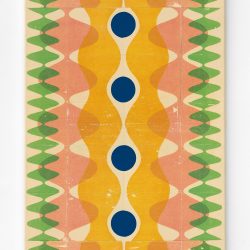
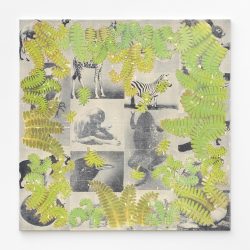
Márk Fridvalszki’s artistic practice is defined by lost visions of the future, layered nostalgia, psychedelia, and questions of human perception. In recent years, however, his life has reached a turning point: two years ago, his son was born. This has introduced a new rhythm and perspective that now resonates strongly throughout his artistic practice. The exhibition Vibin presents the first works of this newly emerging creative phase. The title refers to the musical notion of “vibing” – an intuitive attunement to rhythm and atmosphere. Within the context of the exhibition, the term is understood in an expanded sense, drawing a parallel to the way Fridvalszki attunes himself to a shared wavelength with his child. At the same time, his artistic attitude follows the vibrations of his surroundings, resulting in works with open and multidirectional themes. The creation of the images is characterized by instinctive making and a sense of freedom.
The central term of the works is transcendence, which becomes visible in its anthropological and aesthetic dimensions, as well as within the natural fields of attention and creativity. The exhibition suggests that childhood itself fundamentally embodies such a state: the naive curiosity we possess as children enables a more instinctive mode of experience. Adulthood, by contrast, carries the risk of losing this openness, or limits our ability to think outside social norms to only intermittent moments. Themes that have been present in Fridvalszki’s work for many years reappear in this new cycle; however, the perspective from which he approaches and interprets them has shifted. Owing to this life stage, he has adopted an attitude characterized by childlike wonder, deep immersion in small details, and a sense of liberation. This approach redirects attention to the original, instinctive nature of artistic creation.
This turning point thus brought about a new artistic approach, which also affected the source materials. As in his earlier works, the visual materials are sourced from antiquarian bookshops, record stores, flea markets, and online marketplaces, from which a continuously expanding archive emerges. This time, however, children’s storybooks, childhood pedagogical materials, and youth publications have drawn the artist’s attention. The visual world of The Mole, for example, inspired the artworks Quiet Forest and Blue Forest, while a book by Éva Janikovszky served as the source for Drop That Needle!
In addition, music – long a central element of Fridvalszki’s oeuvre – remains a decisive influence in this cycle. Alongside the books, songs by Vilmos Gryllus had the strongest impact on the works (Quiet Forest; Yellow on Blue, Grey on Red, Orange on Green, White on Black; Morning Laughter Stretches to the Sky), with lyrics reappearing in the titles and thematic content of the images. Jazz also appears as a motif in the series – Jazz with Mario I – representing not only an affection for the musical genre but also a philosophy of life: a symbol of improvisation, risk-taking, collective thinking, and solidarity within the artist’s body of work.
Fridvalszki’s works are produced using a pigment transfer process – a specialized artistic technique – in which scanned archival images are digitally edited into collage- based compositions and then transferred onto canvas as laser prints using acrylic paint. Although he works with paint, he carefully avoids visible brush or palette knife marks – traces typically left by painters – so that the final image acquires a poster-like quality. In Fridvalszki’s understanding, collage functions not only as a technique but a mode of thinking, powerfully exemplified by the exhibition’s eponymous work, Vibin.
Boglárka Tóth