Our latest installment in a series of exhibitions showcasing works from the late 1980s and early 1990s in Hungarian painting—works that were scarcely known in the local art scene and were sent directly from the artists’ studios to be exhibited abroad—may contribute to a deeper understanding of this era.
A defining phenomenon of the early period of Hungarian painting in the 1980s, the New Sensibility became widely known, and looking back in 1987, art historian Lóránd Hegyi described it as three defining, interrelated tendencies.
He identified cultural history as a form of individual mythology, referring to works that evoked ancient mythologies and alluded to imagined rituals and myths that seemed to predate history. He used the term “New Painting” to describe neo-expressionist, abstract, and figurative endeavors, defining the “heftige Malerei” (violent painting) as its historical backdrop, while he referred to Constructivism as the precursor to the post-geometric movement, which was one of the defining modes of thought and creation in the avant-garde and had become synonymous with radical endeavors.
And although these forms of artistic expression persisted into the second half of the decade, the approach to art did change; as Hegyi notes in his essay published in the volume *Second Public Sphere* issued by the gallery, the works of several artists feature deeply intellectual ideas, philosophical and metaphysical content, and even emotional reactions.
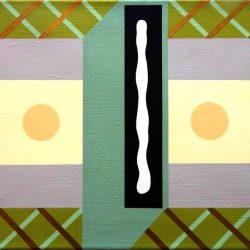
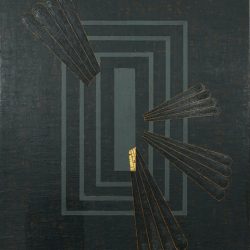
The works on display reflect this experience. Tamás Soós’s mythological landscape is also a representation of “spiritual space” (to use Wilfried Skreiner’s term) and signifies a transcendent horizon. László Mulasics’ compositions, formed from nearly monochromatic surfaces and the simplest of forms, are also visionary, evoking a sense of timelessness, and through them a new conception emerges. István Bodóczky’s work also refers to the cosmos through a system of geometric forms, while defining it as a space of both science and spirituality. Imre Bak works simultaneously with Art Deco-inspired, hard-age, and symbolic forms. He linked the layered nature of the latter to ancient cultures and poststructuralism, yet this way of thinking cast doubt on the stability of signs, leading to an ironic reinterpretation of abstract forms.
The need for broader dimensions—the transcendent and the spiritual—that are missing from everyday life thus emerged in art during a period when new social narratives were taking shape. The challenge of “evoking” and reconstructing the imagined myths and rituals of earlier European cultures, however, lies in conceiving new practices—in providing a broader horizon for shaping the present. To quote Hegyit: “In this new vision, archetypal motifs and facts—from the history of politics and art—were inextricably intertwined.”
An attitude that appeared apolitical did not necessarily imply a dismissive stance toward events in public life. The broader social discourse of the years of transition allowed artists to work in a different role, poetically representing cultural-historical perspectives, and to turn toward metaphysical thinking beyond everyday debates and current dialectics. In the context of the private collection from which the exhibited works originate, several pieces allude to this with humor.