K2 Gallery is delighted to present Róbert Batykó’s solo exhibition, *Cabin Crew*, realized in collaboration with acb Gallery. The gallery’s inaugural exhibition explores a brand-new phenomenon: the impact of artificial intelligence on painting. Batykó (1981–), one of the most distinctive, well-known, and successful representatives of the generation of artists that emerged in the mid-2000s, has built a consistent body of work as a painter. In his artistic world, mechanical gestures blend with pop motifs and digital references. The exhibition at K2 is the first to present—in the form of a solo exhibition—his new series titled *Safety Card*, which addresses questions raised by artificial intelligence.
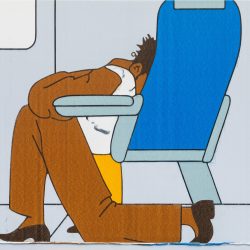
Batykó painted his series titled *Safety Card* in 2025–2026, based on the AI images and generative collages he had created the previous year. A “safety card” is a safety information sheet produced by airlines, featuring easy-to-understand illustrations that explain emergency protocols and what passengers should do in the event of an accident. Batykó fed individual images from safety information panels—which typically use schematic graphic designs—into an early version of an AI image-generating program (Midjourney). Using the uploaded, sometimes pre-manipulated frames, the AI—without any text prompts—generated new scenes resembling “pseudo-safety cards.” The elements of the painting series were created based on these digital files. The generated images inserted into the painted compositions are characterized by the raw, sometimes grotesque, sometimes tragicomic surrealism of early AI programs. The figures merge with their surroundings at unexpected points, flow into one another, and certain elements become blurred and lose their meaning. An inflatable yellow vest becomes an elastic mask, men’s shoes turn into women’s high heels, and legs in fabric pants transform into airplane seats.
With the “Safety Card” series, Batykó not only exploited but also highlighted the unique operational methods of artificial intelligence image-processing software. In their early stages, these programs did not truly understand human anatomy and were unable to distinguish individual elements in space very well. These visual misunderstandings gave rise to a surrealistic visual world, featuring a six-fingered yellow glove and an ear melting like a slice of pizza. These errors do not merely point to the cold, mechanical, “inhuman” nature of the software. The unconscious mechanical “reflexes” of AI image-generation programs can be compared to the Surrealists’ automatic writing (écriture automatique) and automatic drawing. Avant-garde artists shut off conscious control, allowing the automatism of the subconscious to guide their hands. While they sought to shed light on the dark chamber of the psyche through their works, AI companies have tapped into civilization’s collective visual subconscious by drawing on a staggering volume of raw visual data—collected from the internet, often in disregard of copyright—on a scale beyond human comprehension. They follow familiar or unfamiliar visual tropes, written and unwritten laws. They draw Afro hairstyles on brown skin, fuse female and male body parts into unexpected queer centaurs—we can only search for human logic behind their solutions. But in doing so, we also come to understand something from our own intellect.
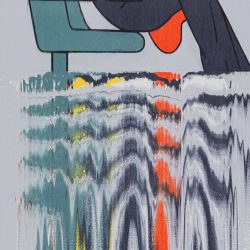
Batykó has enhanced the frames of his safety information videos—which are expressed with functional simplicity—not only with artificial intelligence but also with elements from his own painterly toolkit. For nearly a decade now, his constant “creative partner” has been his self-built “painting machine”—a blade that scrapes away thickly applied oil paint, smearing the pigment scraped from the canvas like a ghostly image onto the empty half of the composition. In the Safety Card series, this spontaneous or semi-controlled surface creation enters into a dialogue with the products of AI-automated image generation. AI software powered by the latest chips finds itself confronted by a studio steel blade crafted by a locksmith. It is as if a futuristic duel were taking place across time planes; in the wake of their clash, the image becomes so fragmented that the very fabric of its flaws now constructs the aesthetic experience.
We must realize that the ever-new inventions of technological revolutions have created a strange—a “brave new”—world for us. Just as it is unnatural—evoking the myth of Icarus—for a primate to soar through the sky thousands of meters above the ground in a metal container, so too is it unrealistic for us to live within the new framework created by artificial intelligence. Standing among Batykó’s latest paintings, the viewer is confronted with the fragile absurdity of civilization. Amid the blurring spectral figures, people turned into objects, and hallucinated objects, we may come to realize that we are all traveling together aboard the high-tech vessel of the Anthropocene. The AI industry has only ramped up the pace even further. We fly together, like the eternal crew of an airline, an imaginary “cabin crew”: we await a safe landing and dread a catastrophe. Meanwhile, we turn to Batykó’s safety briefings for useful advice.