The Institute of Contemporary Art is presenting Gyula Várnai’s major solo exhibition as a highlight of its 2026 exhibition season. Gyula Várnai, a Munkácsy Prize-winning visual artist who lives and works in Dunaújváros, is a leading figure of the middle generation of Hungarian contemporary art. In 2017, he represented Hungary at the 57th Venice Biennale with a project related to Dunaújváros.
His exhibition titled Peace On Earth!, presented at this prestigious international event and realized with the curatorial collaboration of Zsolt Petrányi, juxtaposed the optimistic visions of the past with the uncertainties of the present. The project was built around unique references to the city’s history: it featured elements such as the neon dove of peace that once illuminated the top of the high-rise on Vasmű út and the Ferris wheel from the city’s amusement park. The exhibition examined how various power structures use images of the future, and how these visions of the future actually reveal the social conditions of the present.
Várnai’s thinking and his view of the world and art are fundamentally shaped by his interest in the natural sciences, cosmology, and futurology. The science fiction experiences of his youth and the visions of the future at that time conveyed technological optimism: the eradication of disease, the expansion of human civilization, and the possibility of communication with extraterrestrial intelligence. According to the artist, these scenarios can now be interpreted more as phenomena of their time, having been supplanted by new geopolitical, technological, and social narratives.
The exponential acceleration of scientific and technological progress has fundamentally transformed the reference points that previously seemed stable and unquestionable. In Gyula Várnai’s works, technological optimism gradually intertwines with the recognition of the ecological crisis. Humanity stands at a new historical turning point, where competing future scenarios are taking shape. At the same time, his works do not represent categorical pessimism, but rather explore the possibilities of adaptation and collective survival, reflecting on the situation of a humanity that has reached a turning point and is capable of finding new solutions despite the looming crises.
Although the optimistic visions of the future based on technological progress gradually gave way to pessimistic social visions in the period following 2017, Gyula Várnai’s interest in futuristic themes has remained constant. His body of work from recent years also attests to the unfolding of these variations: the astronaut who landed on alien soil with thudding steps in the 2021 exhibition My First Steps into the Uncertain, held at acb Attachment, has remained in motion ever since. At his 2023 exhibition titled Another Zodiac, held at the Csikász Gallery in Veszprém, his ensemble of objects made with 3D pen and concrete has since been differentiated by new works.
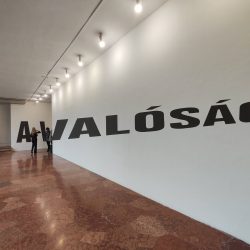
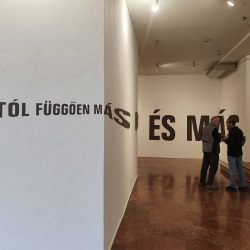
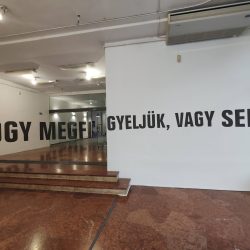
The regularity of the migration and cyclical nature of motifs and thematic explorations is also perceptible in this exhibition: his site-specific installation titled W. H., which was first shown to the public in 1996 at the King Saint Stephen Museum in Székesfehérvár, reappears as a kind of motto and plays a prominent role in the exhibition space. The anamorphically distorted sections of the quote from Werner Heisenberg, painted on the walls, become legible when viewed from a specific vantage point in the Uitz Hall. By extracting the theoretical physics text from its original scientific framework, Várnai transforms it into an artistic experience accessible to everyone, in which, as active observers, we can catch the shifts in our perception of reality.
Astronomy and science fiction continue to inspire Gyula Várnai’s art in the 2020s. His characteristic variations on themes and motifs—his astronauts, aliens, star maps, and depictions of spaceships and robots—also offer him a vast playground in which to explore his “hypercreativity” regarding materials and media, the compositional possibilities of abstract and figurative systems, and the fragments of the past and present—whether collected over time or fished out at random—into a carefree, experimental game of construction. Held on home turf, his large-scale solo exhibition, featuring the artist’s latest works, opens a space into the reality where the future is cool.