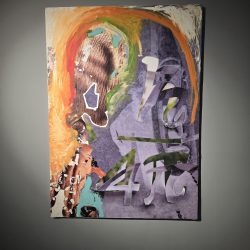
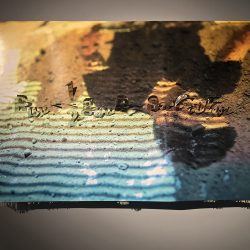
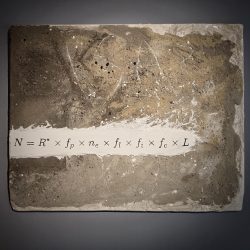
The crossover between science and art is nothing new. From the Renaissance through modernity to contemporary art, many artists have turned to scientific thinking, mathematics, and technology — not simply as subject matter, but as a possible model for image-making and for interpreting the world. Gyula Várnai’s work belongs to this tradition while occupying a distinctive place within it: at the center of his interest lies not the illustration of scientific propositions but their visual and perceptual effect. Várnai treats mathematical and physical equations as pictorial structures that carry both the order of scientific thought and its uncertainties.
In science, a formula has an unambiguous function — it describes, calculates, models — but in the space of art, its status changes. The notational system, the rhythm of the characters, the structure of the equations, and the knowledge presumed behind them become an autonomous visual experience. Modern physics is especially suited to this shift in perspective.
Relativity, quantum physics, and contemporary cosmology have created models of the world that radically reshaped our conception of reality while also marking out their own limits. The standard model of cosmology accounts for entities whose existence we have indirect evidence of but whose nature we know little about. The names “dark matter” and “dark energy” simultaneously designate a scientific problem and a boundary of knowledge — something whose effect we perceive while it never becomes directly visible itself.
From this vantage point, the question of visualization becomes unavoidable. What does it mean to create an image of something we cannot see? What is the relationship between a phenomenon, its scientific model, and the visual representation of that model? Várnai’s works do not close off this chain but rather destabilize it. The formulas appear simultaneously as concrete scientific statements and as abstract images. The exhibition does not aim to erase the boundary between science and art — rather, it makes visible precisely how the two fields operate differently. Science models the world; art is able to question these models as well.
For Várnai, the formula can therefore be both a scientific tool and a material for visual art. He is not interested in numerology, but in the effect that numbers, formulas, and their associated systems produce even when they no longer stand before us as scientific statements but as images.