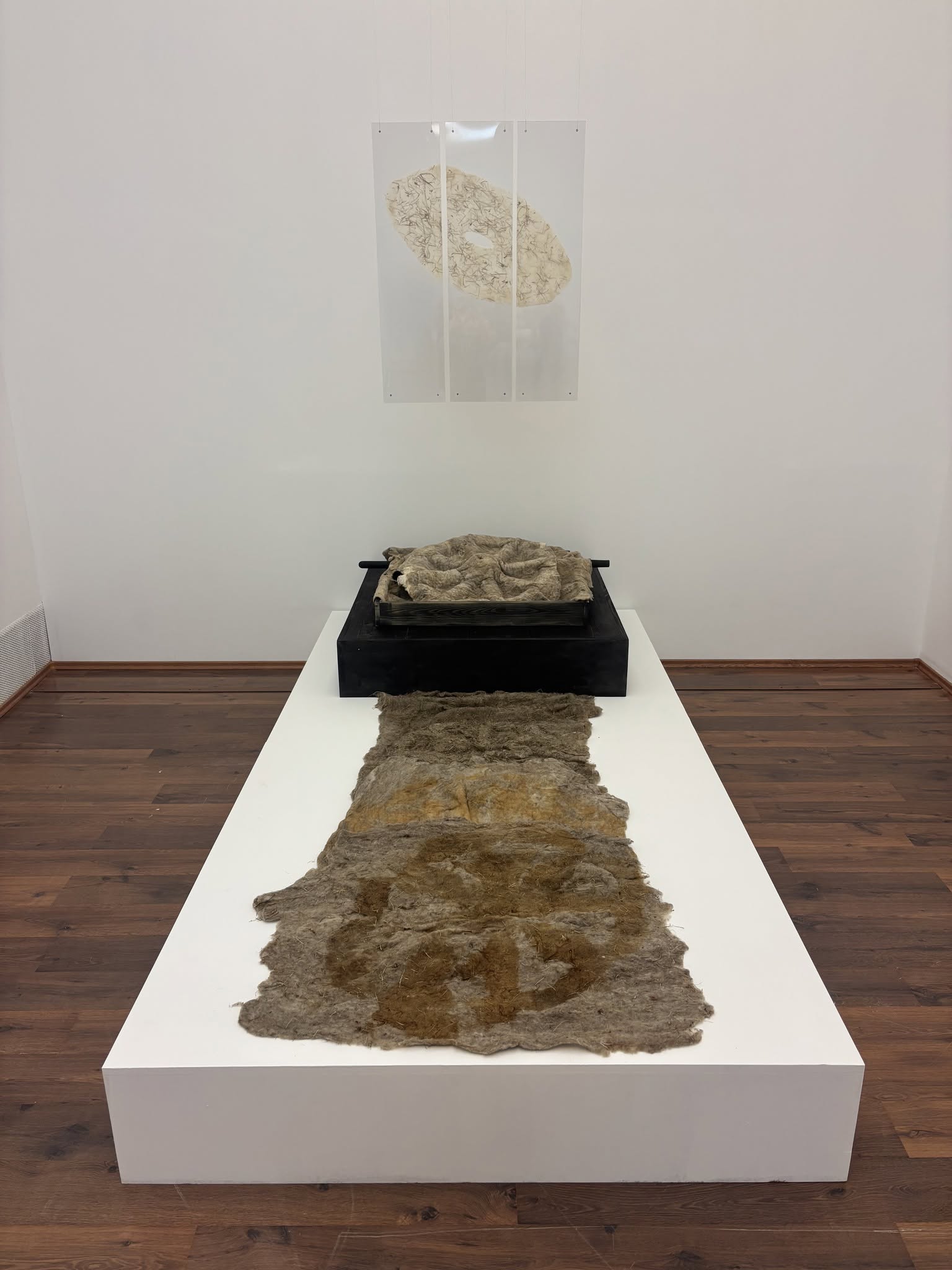
Margit Kányási Holb (1950–2025) began her career at the same time as the Velem Textile Art Studio, founded in 1975, was taking shape; rather than a functional approach, the studio focused on experimentation — specifically, the exploration of spatial, conceptual, and installation-based possibilities. The artist also developed a unique weaving technique, and increasingly combined the technical skills she had mastered through craft practices with a sensitive approach imbued with the conceptuality of contemporary trends, so that autonomous, meaning-generating works increasingly took the place of utilitarian objects in her oeuvre.
In her practice, experimentation with archaic knowledge of weaving is paired with a comprehensive approach to textiles, and her works extend into the realm of fine art expression. Wool and felt paintings, objects, complex installation works, and performative gestures become part of a creative universe in which the material is both an active agent of creation and a means of interpreting the created world. In the mature phase of her career, she does not create decorative surfaces, but rather event-bearing media that define the work through their inherent qualities. She brings to the fore the connections between surface texture and spatiality, the body and memory, and material and psychic reality.
The application, shaping, and deployment of textiles, as well as their placement within a spatial context, often take place within the framework of performance art. The associated movements —concealing and revealing, tying and untying — are, beyond mere technical operations, action-based, time-unfolding acts that generate meaning, often alluding to the individual’s relationship with the community. Memories attached to the medium, acquired professional knowledge, and the intuition derived from tradition — which is difficult to articulate, as it points toward the sacred — serve as recurring sources of inspiration; her work thus bears a resemblance in many respects to that of Ilona Lovas, a fellow weaver of her generation.
Beyond the identity-forming power of physical-material and spiritual connections, the artist’s family as an intellectual milieu also offers perspectives for interpreting his body of work. His shared thinking with visual artist Zoltán Fátyol — despite their differing media and expressive vocabularies — consistently highlights art’s spiritual mediating function. The works created in collaboration with their daughter, photographer Viola Fátyol, open up new perspectives in the artist’s career through the interplay of media and the visual representation of memory.
Margit Kányási Holb’s practice engages in a dialogue with current trends in contemporary art, which are defined by an exploration of materiality and the potential to recreate the body (memory) or rituality. Her works treat textiles as a source of expressive power in which the duality of concealment and revelation, of touch and untouched purity, comes into play simultaneously, in order to convey existential experiences and a sense of trust in a deeper truth.