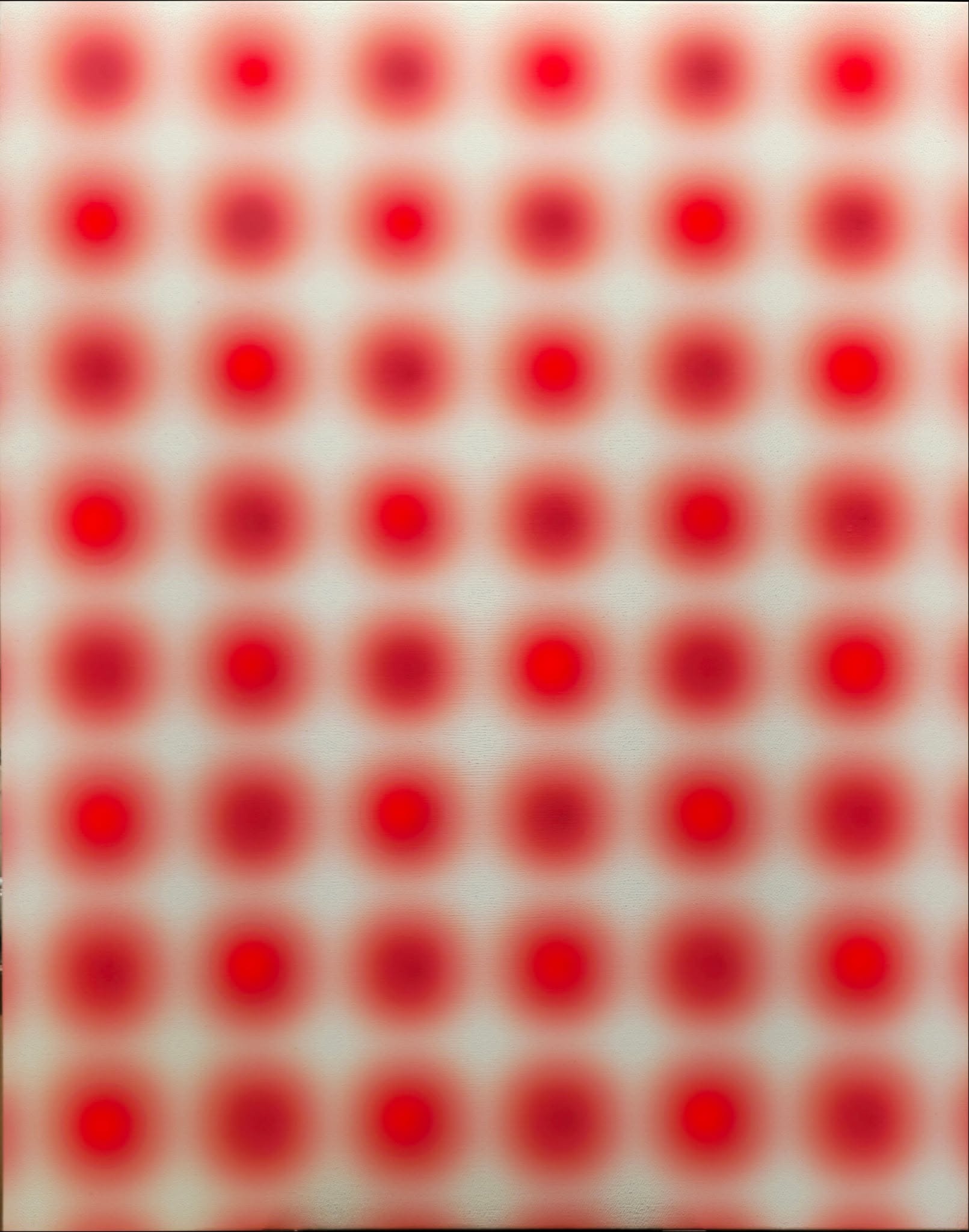
Throughout his creative career spanning several decades, József Bullás has consistently maintained his spirit of experimentation: while steadily developing his own unmistakable visual language, he continues to discover new visual solutions, formal relationships, and painterly formulas. His art thus exhibits both continuity and constant change, in which even familiar motifs consistently take on new meaning.
In his latest works, the tradition of Op Art once again plays a prominent role; in Bullás’s painting, this has never been merely about optical illusions, but rather a free exploration of the relationship between space, light, color, and perception. The vibrating surfaces, rhythmically repeating structures, and subtle blurring once again set the viewer’s gaze in motion, while the geometric planes serve to organize the visual field.
The architectural folds, interlocking planes, and imaginary spatial structures that appear alongside the classic Bullás motifs seem to play with the boundaries of the picture plane—with the concepts of front and back, and primary and secondary roles. At times, the forms coalesce into architectural structures; at others, they unfold with an almost paper-like lightness, repeatedly blurring the boundary between plane and space.
What is particularly fascinating about these compositions is the duality of order and freedom. The precisely constructed geometric shapes, the repetitions, and the subtle shifts create a visual rhythm that keeps the viewer’s gaze in constant motion. The paintings offer both meditative contemplation and an intense visual experience: the image evolves alongside the viewer’s attention, revealing new details and spatial relationships.
All of this is imbued with a distinctive playfulness. In Bullás’s painting, the discipline of geometry never becomes a rigid set of rules: behind the precision lie curiosity, the joy of experimentation, and the search for spontaneous possibilities. The works presented here are thus not merely new stages in a painterly world developed over decades, but also proof that a consistently constructed artistic language offers a flexible space for the unexpected.