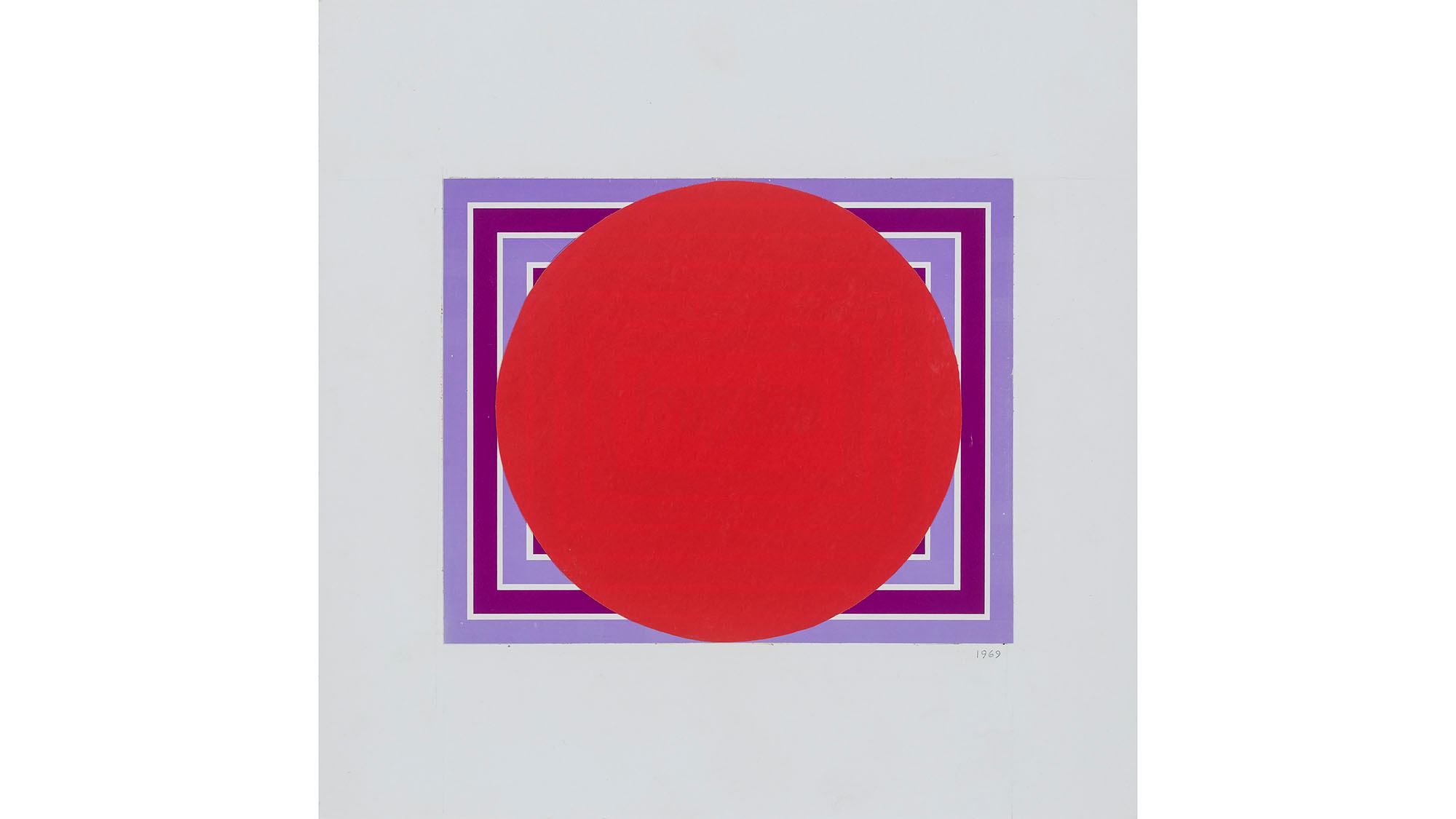
Vera Molnar is a pioneering figure of computer art whose work fundamentally shaped the application of algorithmic thinking in visual art. She spent most of her life in France; in 1947, at the age of 23, she moved to Paris with her husband, François Molnar, where she established her artistic practice. Although her oeuvre is widely known for works created with the use of computers, from the outset her practice was centered on a systematic inquiry into order and disorder, repetition and variation, and the role of chance in visual structures.
In order to make each phase of her investigations traceable and analyzable, she developed a method that initially relied on an imaginary computer, and later on a real one. She referred to this imagined device using the term “machine imaginaire”, borrowed from her friend, the French composer Michel Philippot. At first, she executed algorithms manually, step by step, in the form of hand drawings.
Molnar was among the first artists to use a computer in the creation of visual artworks; she began working with a real computer — “machine réelle” — in 1968. From that point on, the computer performed calculations and generated all possible variations of a given problem. However, this process is not merely a technological issue but also a visual and aesthetic one, which can be understood through the concept of redundancy. Redundancy refers to the repetition of visual elements that allows the perception of structure, yet becomes aesthetically compelling only when disrupted.
A central concept in Molnar’s work is what she termed “one percent disorder”. The term refers to a minimal deviation introduced into an otherwise perfectly ordered system—without which the image would remain visually inert. In Molnar’s practice, chance is never arbitrary; it is always embedded within a predefined structure, heightening its perceptibility. Order and disorder thus unfold not as opposites, but as mutually constitutive conditions.
The works presented in Ensemble de collages are created using collage, a medium that recurs throughout Molnar’s oeuvre over several decades. Built from simple geometric elements — primarily squares, circles, and their transformations — the compositions evolve through gradual shifts, rotations, and distortions. For Molnar, art is not the creation of a final form, but an ongoing process of investigation in which the image continuously transforms and unfolds through variations. The collages make this thinking visible: they simultaneously bear the traces of manual intervention and the logic of a rigorously constructed system.
Her works are currently on view in the solo exhibition Possibilities at the Kunstmuseum Basel, and in group exhibitions including New Humans: Memories of the Future at the New Museum and To Open Eyes – Regards d’artistes at the Centre Pompidou Málaga.
Boglárka Tóth