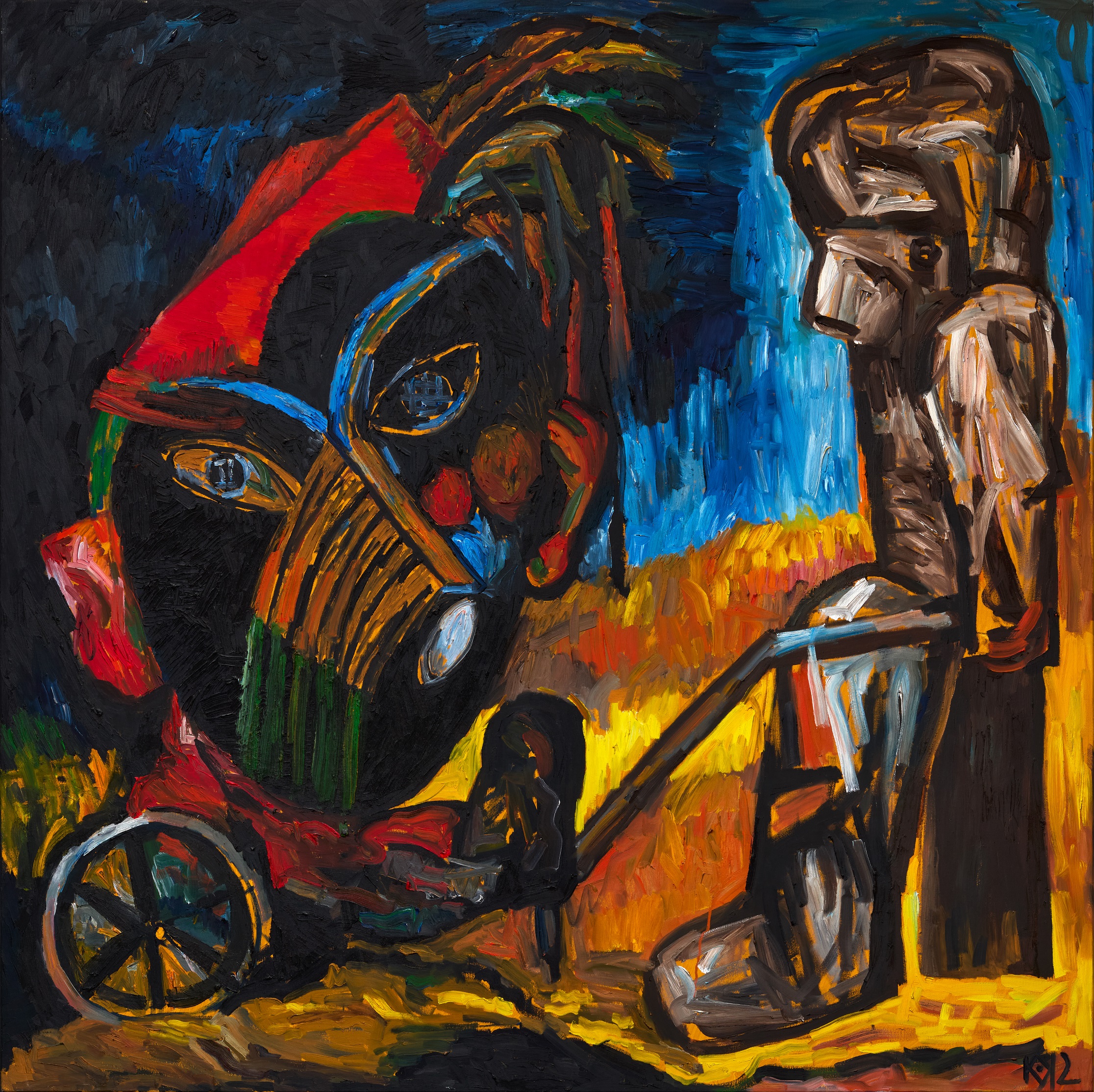
Szanitéc Teddy is pushing Picasso’s palette on Baselitz’s wheelbarrow; 2002
The exhibition aims to provide a comprehensive overview of the artist’s body of work spanning several decades—featuring some 150 works—across the defining periods of his career. Károly Kelemen’s body of work represents one of the most significant achievements of the Hungarian neo-avant-garde and the postmodern turn. Following his conceptual experiments of the 1970s—having reached the ultimate limits of non-objective art and the exhibition’s “zero point”—the artist consciously returned to panel painting and the creation of physical objects. The early, conceptual phase of his career is evoked in the exhibition through the most characteristic excerpts from a video interview conducted by Orsolya Drozdik—previously unpublished—to help visitors better understand the background of Kelemen’s theoretical approach to painting. At the heart of his artistic philosophy lies a firm rejection of egocentric “subjective” painting. Instead, appropriation art (appropriation, citation) and critical reflection become the core of his message.
Kelemen himself developed the “eraser painting” technique, which has become one of the hallmarks of his art. Born at the turn of the 1970s and 1980s, this technique—in which images are applied to canvas with an eraser and then partially erased, evoking and simultaneously subverting the classics of the avant-garde (Warhol, Beuys, Pollock)—was revisited by Kelemen in the early 2000s, leading to the creation of his series *Indelible Communism*.
In the “New Sensibility” exhibitions, which began in 1981, Lóránd Hegyi assigned a prominent role to Károly Kelemen as an artist who was the first in Hungary to raise the issue of the crisis of modernism and the avant-garde, and who, in contrast to conceptualism, represented a sensitivity to materials and subjective historicism.
Following his monochrome eraser drawings, Kelemen’s painting became increasingly colorful. His monumental tarot card paintings were followed in the mid-1980s by the elevation of the Teddybär figure to a universal icon on his canvases. The culmination of his polemic with art-historical memory and the avant-garde’s “transformation into museum art” is represented by his reflexive variations on Pablo Picasso’s *Les Demoiselles d’Avignon*, the work that launched the avant-garde revolution.
In his 1997 non-figurative series, he glued glass eyes onto the canvas, which simultaneously represented, for Kelemen, the “revitalization” of “dead abstract” painting and drew attention to the reciprocity of the relationship between the viewer and the artwork. In his 2006 Kassák series, he recolored Sándor Bortnyik’s linocuts, effectively paraphrasing and inverting Andy Warhol’s series of portraits of the stars of his own era.
The exhibition organically combines theoretical depth with visual appeal: it demonstrates how the rewriting, deconstruction, and reconstruction of the classics become the foundation of a unique, subjective historicism.