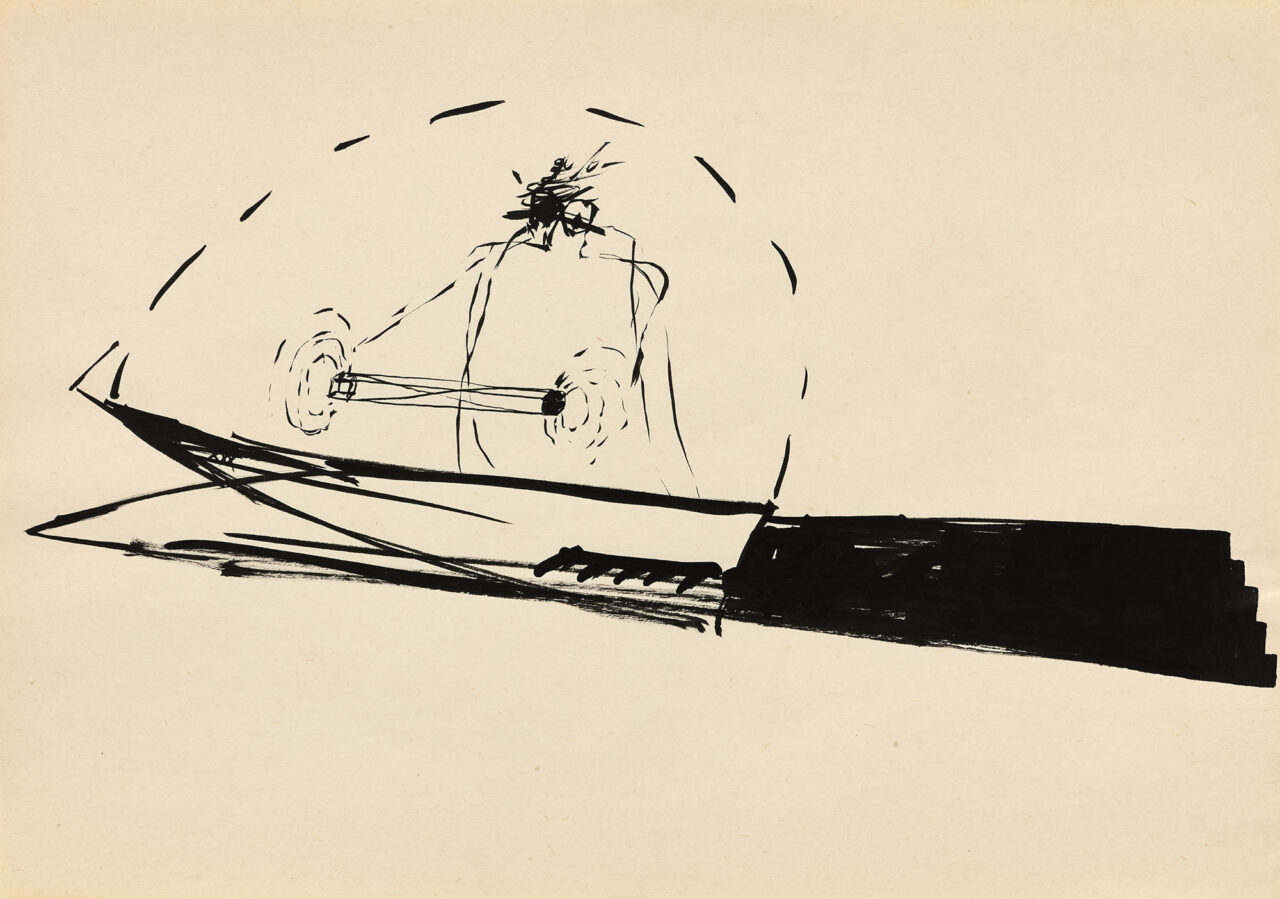
The exhibition is a non-chronological montage compiled from Kamilla’s works and sketchbooks created in the late 1980s and early 1990s. It offers a fragmentary glimpse into the creative process through which a radically simplified, minimalist visual language gradually crystallized from figurative representation.
The starting point is the figurative articulation of personal experiences, difficult situations, and traumas. Various observations, graphic motifs plucked from television, the condensation of fleeting life into lines, and the depiction of pain appear as a form of self-revelation. At the same time, the shift away from figuration is not merely a formal change: it is a process of creating distance from one’s own experiences and gaining perspective on them. The path thus leads from the personal toward a broader — in Kamilla’s words — cosmic condition.
Recurring figures in the works are entities that the artist refers to as “beings”: figures, forms, and objects that embody states, experiences, and situations, and possess an independent presence within the artist’s artistic practice. They may be formations reminiscent of living beings or humanoid figures, presences that are difficult to define, or even everyday objects and situations created from objects. A knife, rain, a haystack, a tower, figures clinging to one another, or a staircase—each could become a symbol of an experience, a state, or a system of relationships. The process, however, is by no means linear. The apparent linearity is disrupted by sudden shifts in direction, gestures that rewrite emerging rules, and disruptive elements that intrude into the system.
For this exhibition, we have selected works from Kamilla’s first period that are deeply personal and intimate. At the same time, her flipbook reveals important turning points in her artistic practice: that open, experimental evolution in which personal pain gradually gives rise to refined forms, lived experiences to entities, and those entities, in turn, to increasingly independent, unique abstract figures. These gradually coalesce into a visual language that opens up to dimensions beyond the personal and to more distant contexts.
The exhibition features a selection of ink versions of pencil drawings created in a sketchbook between 1986 and 1987, many of which were published in the weekly magazine *Élet és Irodalom*, beginning with the February 1, 1991, issue, which was illustrated in its entirety by Kamilla’s graphics, accompanied by a poetic introduction by visual artist Gábor Roskó. We searched for photographs of the knife-and-staircase object installations taken during her studies in Germany for the exhibition, but they remain hidden in the labyrinth of her personal archives.
For now, the studio photographs taken by Jann Simone Zollna are preserved on the cover of the December 1998 issue of *Beszélő* and as the opening image of the “Játéktér” column. It is interesting how these works have also been preserved within the framework of the social and political realities of the past. This is a peculiar convergence of texts and images that, although not originally directly connected, have nonetheless become shared documents of an era’s print media.
Thus, a historical overview of the press coverage of the years following Kamilla’s return to Hungary has, intentionally or unintentionally, become part of this retrospective. By reading her works alongside contemporary reviews and exhibition reports, the art-historical and theoretical history of the reception of her artistic practice also emerges. It is the story of an attempt to situate, interpret, and fit an increasingly reductive, unconventional creative practice into conceptual frameworks that adhere to the canon.
Lívia Páldi