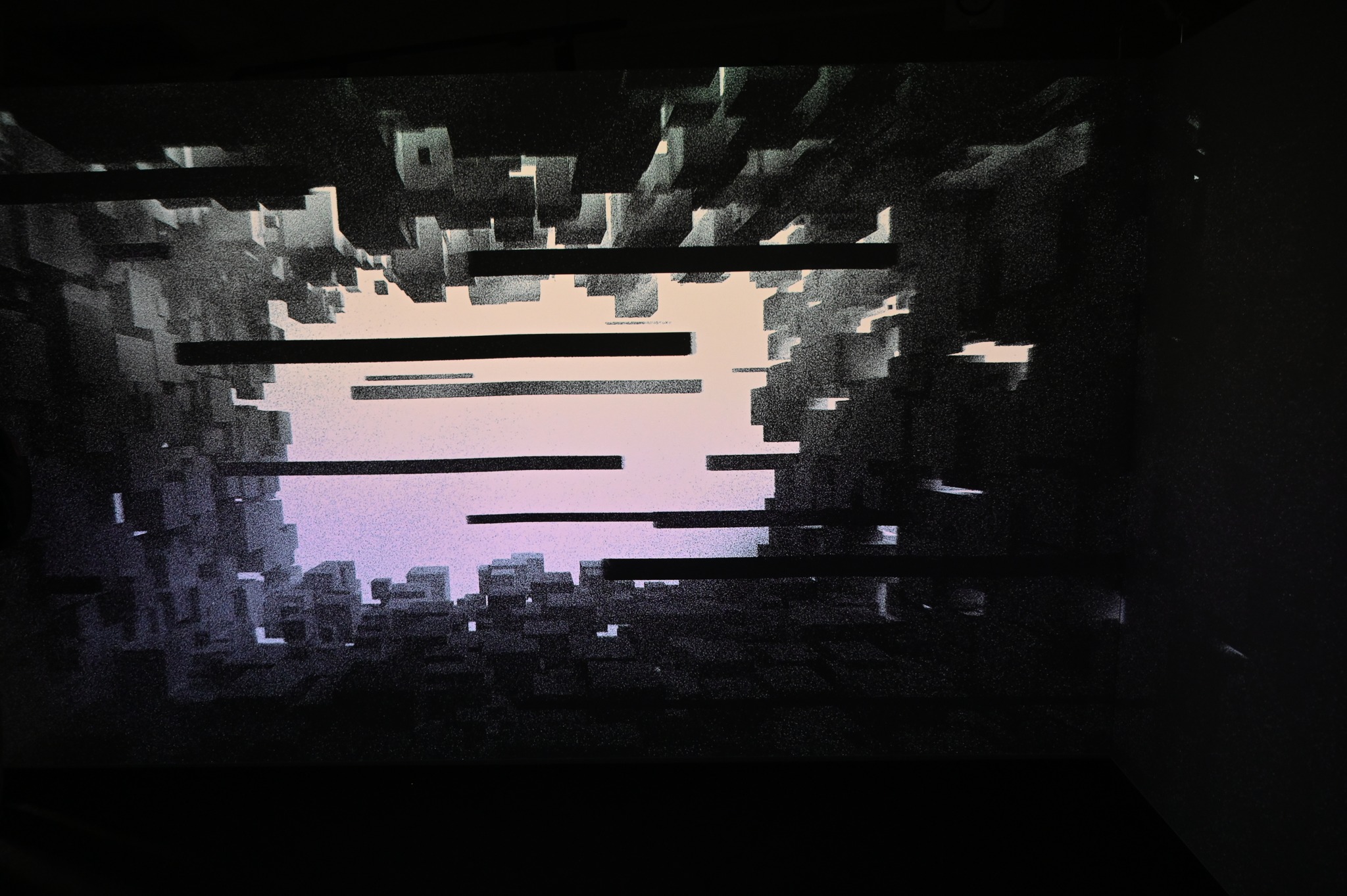
Liquid Horizons explores the ontology of computed spaces: the state in which the digital environment is no longer a representation of physical reality, but an autonomous, self-generating space. Its looped panoramic field, composed of six visual stations, does not follow a narrative: the digital threshold rife with glitches, the brutalist concrete labyrinth, the biological vascular network generated by artificial intelligence, the pure geometric order, the spectral veils, and the synthetic horizon do not surpass one another—they overlap as equal aggregates, arranged into a single continuous event.
At the heart of the work lies the question of the dreamlike sublimation of trauma. The brutalist scenes of the projection—reflected concrete stairwells, half-finished stadium interiors, corridors leading nowhere—preserve the architectural imprint of contemporary war destruction: an algorithmic monument to a suspended future. Not as documentation, but as a weightless data stream—the software does not depict the destruction, but dreams of it. Through this digital dreamwork (Traumarbeit), the raw concrete is sublimated into a pulsating network, a pure geometric order, and then into a data-aesthetic saturated with calculated, majestic light—without the loop offering redemption. The cycle closes.
According to Vilém Flusser’s concept of the technical image: light comes not from sunlight, but from global illumination algorithms; the texture of the canvas is definitively replaced by the texture of the shader code. Gilles Deleuze’s theory of Le Pli (The Fold): matter is not a static object, but an infinitely modulable event—brutalist closure and liquid freedom form a single topological unit. In Marcos Novak’s liquid architecture: digital space breaks with gravity and functionality to become pure mathematics and sensation.
The work’s visuality is defined by the simultaneous presence of three image-generating logics: real-time rendering (Notch), style transfer mediated by artificial intelligence (Stable Diffusion), and digitally processed built spaces. There is no sharp boundary between the three layers—and this is itself the work’s thesis: the distinction between “manual” and “automatic” image generation becomes meaningless in the era of the computed image.
Following the model of Marc Augé’s non-places: human points of orientation are absent from the projected environment. There are no doors, paths, or tangible surfaces. The visitor’s own physical body remains the sole subjective fixed point in this amorphous, post-Anthropocene data landscape—whose horizon does not separate the sky from the earth, but unites them as a data plane.