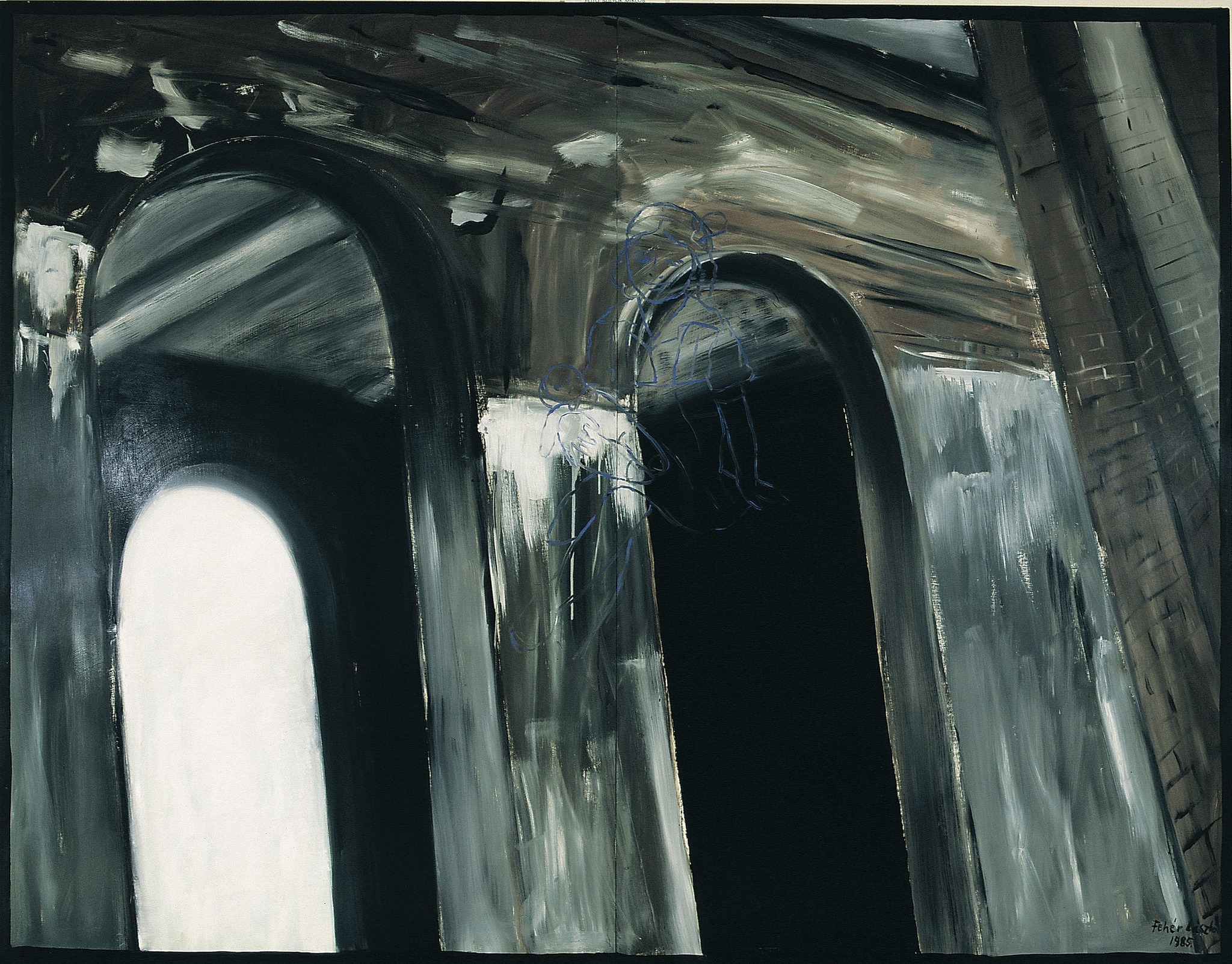
The exhibition presents a selection of paintings by László Fehér created in the 1980s. This decade marks a defining period in Fehér’s oeuvre, when personal memory, collective historical experience, and— in certain works—photographic visual sources coalesce into a distinctive painterly language. The often blurred, translucent figures reflect the fragmentary nature of images of the past and of memory itself. The compositions produced during this period evoke both the intimate space of personal recollection and the collective experience of history.
„Fehér’s paintings raise us out of reality, yet still permit no escape. Fehér is not interested in the reality of reality, but rather in its irreality. It is his world, his worldview that he portrays—his “worldmaking”, an understanding of reality that Nelson Goodman showed to be the more appropriate way of grasping the world. Everyone creates their own world. Fehér’s symbolic images are, as it were, the set pieces from which he constructs his world. We experience them and perceive the transparent figures within them. We are prepared to identify with them after recognizing, with a sense of astonishment, their disembodied structures.
Yet this identification can only occur through the activation of our own memories. These make us aware that identification with László Fehér’s remembered images becomes possible only through our own remembered images, through our own consciously recalled past. In such moments of inward reflection we experience the symbolic power of his pictorial subjects, whose roots reach deep into history. Suddenly we feel the stillness of the moment that fills us when we rediscover things long past. They surround us and bring us face to face with the ultimate, fundamental questions of our existence. This is the important message of the painter László Fehér, expressed through his paintings.”
Excerpt from Wilfried Skreiner: The Search for Things Past. Thoughts on the Image-world of László Fehér