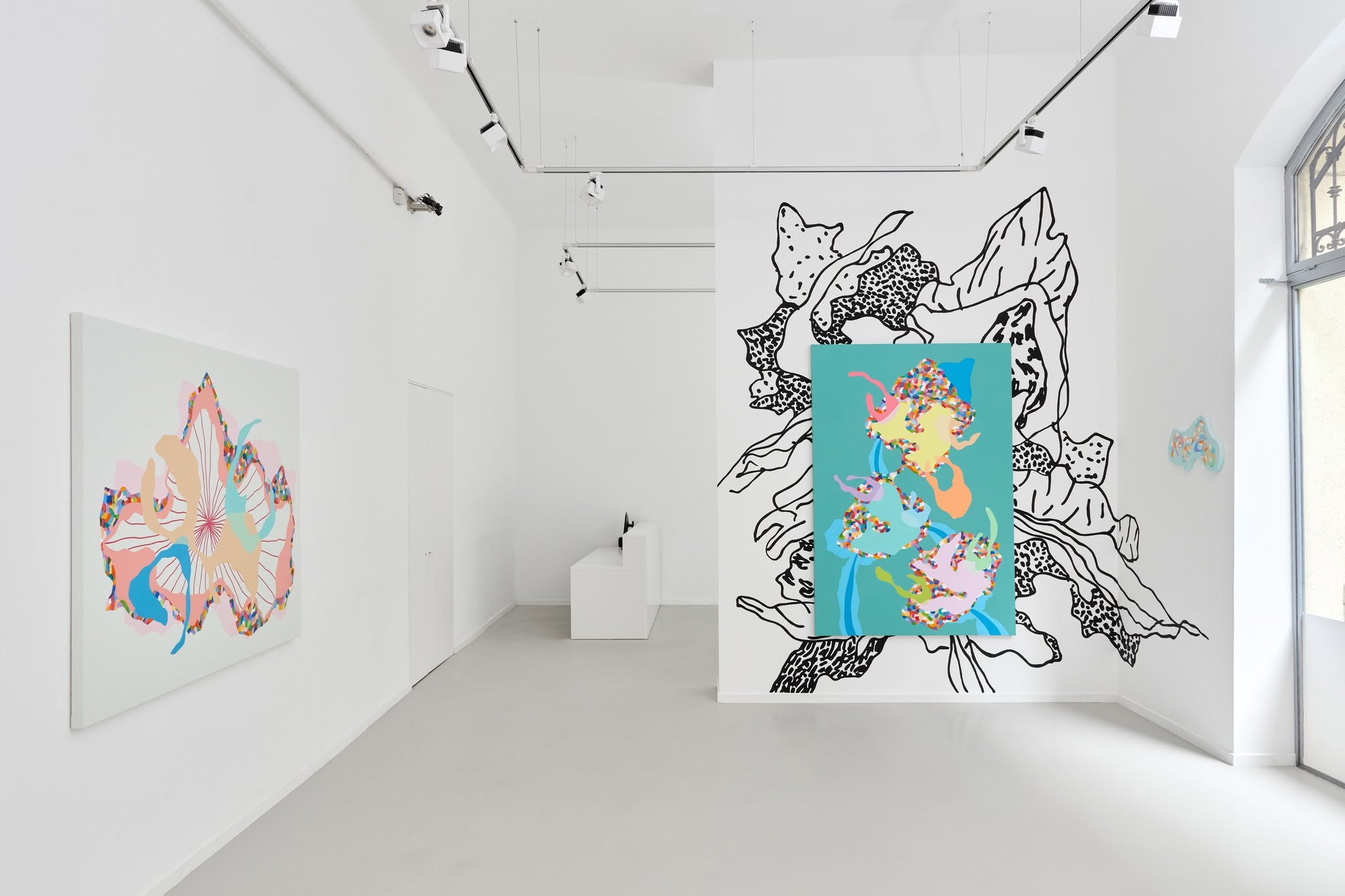
The exhibition *Under the Breathing Sky* simultaneously reveals the essence of Barabás’s painting and its spatial extension. The works explore the relationships between color, form, line, and texture through forms that approach and collide, merge and separate, float and intertwine. The question of connection and interrelationship is not merely formal, but an organizing principle that permeates the entire exhibition.
At first glance, Barabás’s painting creates an organic, protective environment: his bold colors, sinuous lines, and impasto layers give rise to surfaces that are in motion and breathing. The interpretation of the shapes floating in the abstract color fields is fluid: they can be read both as cell-like structures and as landscapes viewed from a bird’s-eye perspective. River-like veins and pond-like forms emerge, eventually coalescing into a system, a breathing whole.
In the title painting (Under the Breathing Sky, 2026), the artist’s earlier black-and-white, gestural strokes characteristic of the late 2000s return. The thick black brushstrokes stretching across the pristine white surface are held together by a furrowed, deep-blue ring; irregular, horseshoe-like forms settle upon the amoeba-like color formations. These are connected by tentacle-like links, as if the image were organized according to its own internal logic.
In the exhibition, the architecturally layered forms emerge from the pictorial surface, transcending the boundaries of painting to enter physical space. Arranged like sculptures, they form a labyrinthine forest, freed from the constraints of the rectangular picture format. The black-and-white linear motifs creep into the inner openings of the sculptures, where time and space are thus layered. Elsewhere, the dense, multicolored surfaces applied with a broad brush evoke the CoBrA group, reminiscent of Karel Appel’s striking color palette and thick impasto, while contemporary parallels also emerge: Carol Bove’s spatial thinking and Julie Mehretu’s graphic complexity both influence Barabás.
The exhibition’s title is taken from a line of poetry by Krisztina Tóth: it evokes layering, rhythm, and movement beneath an all-encompassing sky. A sense of fresh air, serenity, and forward-looking openness permeates the space, where breathing appears as a metaphor for renewal and regeneration—on both a cellular level and a cosmic scale. Zsófi Barabás’s paintings and sculptures are organized like a stream of consciousness: the artist captures the unfiltered flow of thoughts, linking inner monologues, sensory impressions, and memories in real time. All of this coalesces into a non-linear yet deeply personal narrative that offers the possibility of finding one’s way through life’s labyrinths.
This process also engages the viewer: the works encourage us to develop our own paths of interpretation and to assimilate Barabás’s visual language into our inner monologue. They convey a cheerful perspective nourished by these connections, reminding us that we are all part of the same infinite space. Through the system of relationships formed between the distinct forms, Zsófi Barabás creates a unity that comes together as a living organism—becoming a breathing, all-encompassing presence. Her organic abstraction ultimately unfolds like a vast sky, carrying the promise of fresh air.
Hanna Claris