Umbra Images / Swamp Images
Reflections on the painting The Animal Tale (In the Vineyard)
We have arrived at a lukewarm, steamy, mist-shrouded swamp world…
A fairy-tale world, a magical world… Nothing but mud and mire. This is a raw place, full of passions, a battlefield where the desire for beauty, love, and immortality is eternal. Beware, we can easily sink! A dangerous environment, yet uniquely beautiful and alluring; indeed, for some reason, it can even be called home. Solid, liquid, and gaseous all at once. A lush green, but even more so a kind of brown—the realm of the color of decay, of umber. (The gray base of the painting is natural umber lightened with titanium white.)
Let us savor this word! Umbra… Umbra — a kind of brown, a broken color outside the rainbow. The color of the dead world. The color of decay. The matter of living organisms transforms, changing its nature — with the onset of death. “Pulvis et umbra sumus — We are dust and shadow” (Horace) The mineral of umbra is brown iron oxide containing silicic acid (see Limonite), which is rich in manganese and always contains a small amount of aluminum. It is found in the greatest quantities on the island of Cyprus. What does this word of Latin origin mean: companion, night, underworld, shadow, shadow world, shadow image, peace, twilight, tranquility, protection, darkness, spirit world, skeleton, defense, seclusion, shadows of the dead, shadowy place. In painting, umbra has been the color of shadow for centuries. These days, it’s a suspicious, “red flag.”
Somehow — unpleasant. Not very cheerful.
The glass palaces and steel structures of our modern world crave, above all, dozens of abstract backdrops rich in saturated, vivid, spectrum-filled colors. Beware: diversionary tactics are at work in our homes as well! Every object and prop that surrounds us serves this purpose. Our world of seconds dictates this. There are specific colors and forms for maintaining our pleasant sense of comfort, which feign harmony. We feel that this is the only way we can function. Distracted, dazed, “cheerfully” consuming everything we can get our hands on. Because that’s how we endure… Brown is harder for the stomach to digest. If not unpleasant, then at least suspicious. Some call it “shit-brown.” And it’s true. It is an indispensable basic element of the system, its driving force.
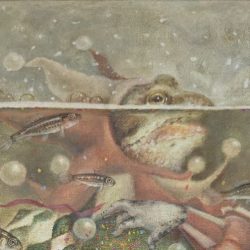
Let’s see: what is happening here, where dragonflies flash by, and from time to time don blue-tinged wings to dazzle the old Rana arvalis with their beauty, which seems to be resting for a moment in the soft embrace of the dense frogbit. What brought tears to the old animal’s eyes? Who is he, what is he, what a longing figure; a beggar for dragonfly beauty. Then — in an instant, the enchanting blue insect is already in his mouth; the wing and the dragonfly’s thigh crackle. The amphibian’s stomach fills slowly.
And oh dear, what do we see down below? The dragonfly nymph (a mayfly larva) is about to satisfy its hunger with a tiny frog tadpole, while the other frightened little creatures flee. Trouble is brewing, disaster looms. Bubbles rise, float, and burst. Slowly, darkness falls, only to give way to a new dawn. The painting titled Animal Tale (In the Vineyard) is part of a loosely connected series currently in progress, provisionally titled Umbra Images/Marsh Images.
Kinga Hajdú
From the Depths
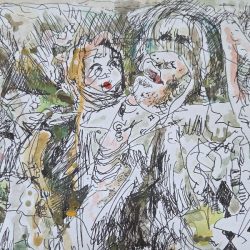
Since the early 2020s, I have been drawing more and more alongside my work as a painter. I work in various sizes, sometimes combining drawing tools with color, other times simply using charcoal or pencil on paper. In and of itself, this was nothing new; after all, the experience of drawing and an awareness of its importance have accompanied me throughout my entire career. I have always taken great pleasure in preparing my paintings through drawings. Very often I viewed drawing as a kind of studio waste; it was precisely in this sense that a change took place within me—something new began to occupy my mind. Drawing itself, as an independent form of expression, began to interest me.
I, who throughout my entire career have viewed the transformation of contemporary art into a post-industrial industry with considerable skepticism — and who began my career by painting my work titled The Death of Painting multiple times — have come to view the flood of images that surrounds us in an increasingly overwhelming manner with growing suspicion. There are plenty of still images around us, too, but the immeasurable quantity of moving images weighs so heavily on our senses that it practically extinguishes all our attention, concentration, and sense of quality — the core values of traditional European culture.
I began to wonder what an old-school, aging European artist like myself could do in this situation. I became increasingly aware of the futility of success–oriented thinking, the desirability of creating without ambition, a kind of artistic attitude in which the artist in question turns to the simplest and most direct artistic tools—paper and pencil.
If the desire to express myself is already at work within me, and I want to understand and articulate the events happening around me; if I already possess creative energies and cannot and do not wish to give up my artistic activity, then I should do so in my art in the simplest, most discreet way possible, in a manner that disturbs others the least. I have no need to make a big fuss about my affairs; I do not wish to draw the viewer’s attention to myself for even a moment.
I’m fascinated by the intrinsic quality of the drawings. I also like that they demand attention — more, sometimes much more, than is generally expected or practical. I try to spend a lot of time on them: I compose my drawings in a complex way, with many layers of meaning. If the viewer doesn’t devote as much time to them as I would consider ideal, that’s fine too. They don’t make a big fuss — if you like, they can be ignored. That said, it’s important to me that I create these works with the highest possible standards of quality. Taking the European drawing tradition into account to a great extent is of fundamental importance to me, just as is the incorporation of specific innovative steps at certain stages of the creative process.
Certain themes generally occupy me for longer periods of time—thus the drawings come together as series. This is how the series of Zichy paraphrases titled The Tragedy of Man came into being, as well as the Adventures of Tamás Szentjóby series; similarly, the small drawings created under the theme of Workshops and Model Tables, the sheets exploring the theme of Climate Anxiety, and my mythological drawings all took shape as series.
I have many plans; I would like to bring them to fruition.
János Kósa