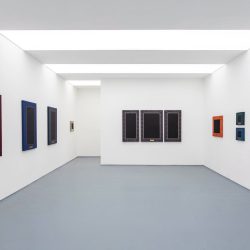
The acb Gallery is presenting an exhibition of works from Endre Tót’s series created in the 1990s, coinciding with the presentation at Art Basel of the artist’s questionnaire-based works created one and a half to two decades earlier. Alongside Gladness and Rain, Zer0 is of key significance in Tót’s oeuvre: his entire body of work is organized around these fundamental “ideas.”
The concept of nothingness — so vital to conceptual art — and its unique aesthetic connect the “blacked-out images” now on display with other works built around visual absence. In Tót’s early artist’s books—such as Night Visit to the National Gallery or My Unpainted Canvases — the principle of “distant yet present” (Alfred M. Fischer) was already articulated at an early stage.
Just as in his early print concept — in which he reworked the Mona Lisa into an empty rectangle and then inscribed it with the caption “the smile is somewhere here” — the artist restructures the relationship between conceptual and visual meanings through his “images of absence that are present,” while activating various layers of collective and cultural memory.
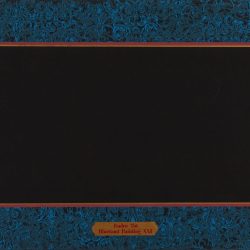
The initial empty rectangles, accompanied by image labels, were joined in the 1990s by image spaces filled with black — yet also empty in this sense. These works speak through the data of press photographs on a historical scale (or, in the spirit of “Zero,” by stripping away all information).
The “blackout” images are among Endre Tót’s most politically charged works: they explore the workings of censorship and power, issues of memory politics, and the social role of images — all while maintaining the artist’s characteristic dry humor and irony.