How did a painter active in the Hungarian art scene of the 1950s, following his time in Romania, become an émigré artist creating abstract works? History rewrote János Antal Kazinczy’s career time and again. During World War II, his works were destroyed in a bombing raid on Bucharest, and in 1956, his studio in Budapest was hit by a bomb.
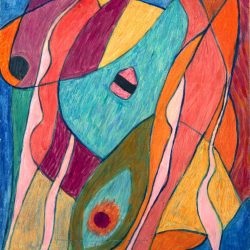
After the revolution was crushed, he left Hungary; in exile, he created his colorful enamel works at night in Germany, and later earned his living as a successful jeweler in France. Meanwhile, he created an increasingly free and experimental artistic world. He progressed from early figurative works through vibrantly colored enamel pieces to lyrical, organic, and geometric abstractions.
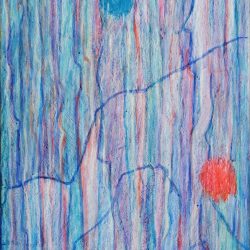
Kazinczy’s spirit of experimentation remained with him until the end of his life. He painted, drew, and worked with wax and ink on Japanese paper; he even created compositions on plexiglass panels in which the cast shadows of the drawn forms became part of the artwork. His works bring together elements of surrealism, Eastern calligraphy, mythology, and nature.
Although his works are included in the collections of the Hungarian National Gallery, the Budapest Municipal Art Gallery, and the Musée d’Art Moderne in Paris, the name János Antal Kazinczy remains virtually unknown to the wider Hungarian public even today. Yet even during his lifetime, he exhibited in Munich, Paris, and Stockholm, and in Hungary, his works could be seen at venues including the Ernst Museum, the Ferenc Kazinczy Museum in Sátoraljaújhely, and the Vaszary Art Gallery in Kaposvár.
In 2024, the Inda Gallery began a more comprehensive presentation of Kazinczy’s oeuvre. The first two exhibitions in the series focused on different creative periods of his career, while the third and final exhibition also sheds light on the artist’s network of relationships and his artistic and intellectual milieu.
Alongside some thirty works by the painter, the exhibition features several pieces by two of his close artist friends — Tamás Lossonczy, a pioneer of Hungarian abstract painting; Endre Rozsda, a significant figure in Hungarian-French surrealism; and Endre Bálint, a founder of a school within the Hungarian avant-garde.
Another unique feature of the exhibition is that János Árpád Kazinczy, the painter’s son, is given his own gallery. The younger Kazinczy often collaborated with his father on his creative work; today he is the curator of his father’s oeuvre, while he himself creates sculptures, assemblages, and wall objects. The juxtaposition of the father’s and son’s works tells the story of two generations: both of their lives were shaped by emigration, moving between countries, and starting over.
An intriguing question raised by the exhibition is how changes in the political environment transform an artist’s body of work. In the 1950s, Kazinczy worked within the constraints of Socialist Realism, which — according to critics at the time — he was unable to fully meet. During the 1956 Revolution, he created works that directly responded to the events, including the painting *Csizma Square*, which ironically depicts the remains of the toppled statue of Stalin.
After his emigration, his earlier figurative style was increasingly replaced by vivid colors, playful forms, and abstract compositions. The freedom he had been denied in his previous political and artistic environment became strikingly evident in his art. The journey from his early realist paintings to his later colorful, abstract compositions is also a story of his search for personal freedom.