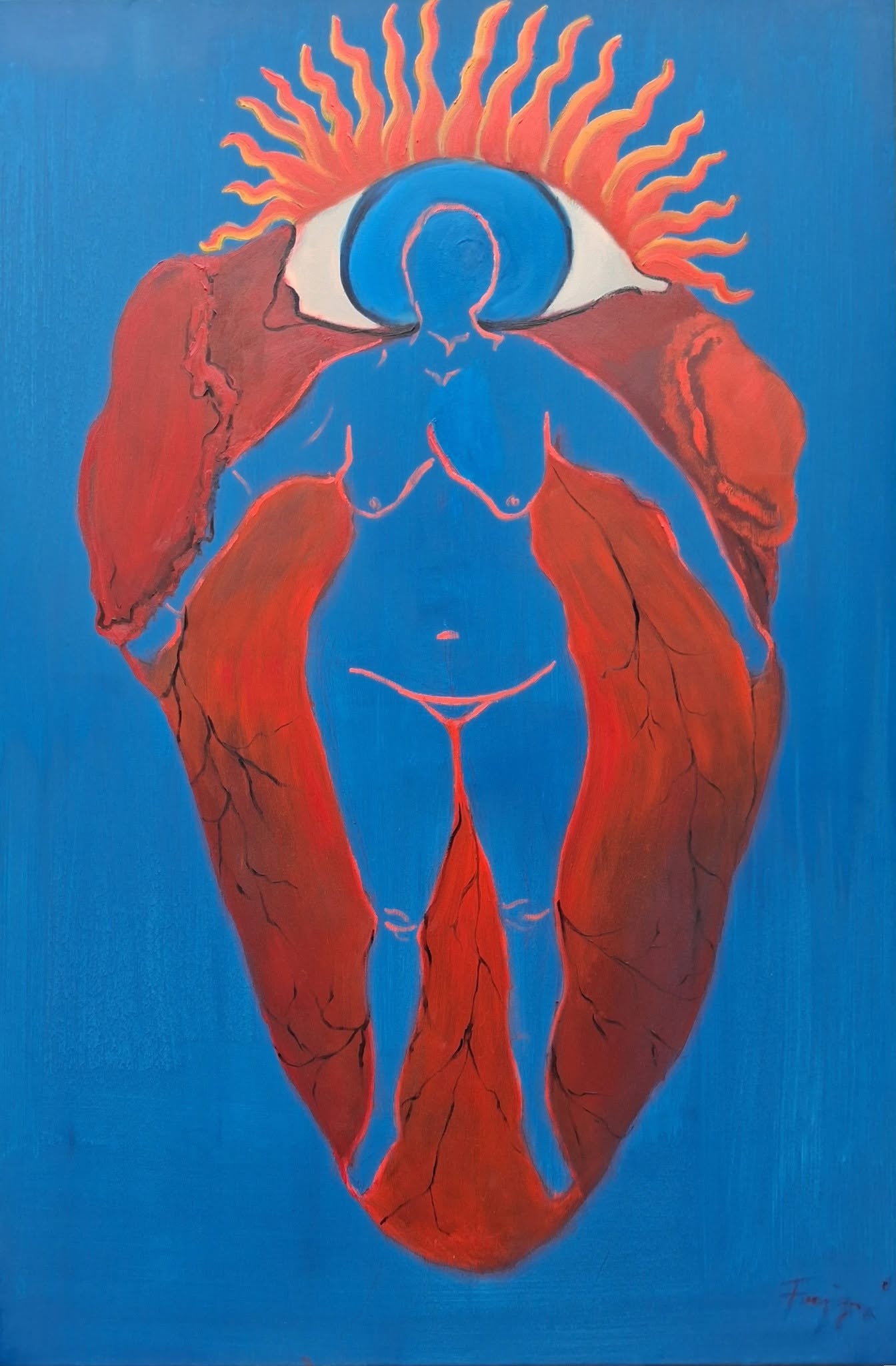
In her most recent works, Andrea Fajgerné Dudás explores the experiences of mortality, death, and bereavement, confronting the loss of her husband. The uncompromising honesty and willingness to challenge taboos that have long characterised her artistic practice now assume an unprecedented degree of personal intimacy. Yet one of the most painful experiences of her life transcends the confines of autobiography: her personal loss acquires a universal dimension, allowing viewers to experience almost viscerally the physical weight of pain, absence, and solitude.
Throughout Fajgerné’s artistic practice, the body has consistently functioned as a medium, a subject, and a personal archive. In her latest paintings, this body becomes the grieving body: one that continues to live while carrying within itself the traces of the past, pain, loneliness, and a profound sense of helplessness. In some of these works, Fajgerné depicts her husband’s figure as a hybrid being, as though inhabiting an intermediary realm suspended between presence and disappearance, life and death. The visceral materiality of her own flesh evokes the corporeal imagery of Jenny Saville, while references to Guernica intensify the multiple layers of Fajgerné’s suffering and underscore the collective dimension of human anguish. Personal tragedy thus remains profoundly intimate while simultaneously transcending the individual narrative, pointing towards the universal inevitability of death.
The iconography of these works also incorporates Durga, the warrior mother goddess of Hindu mythology. Traditionally represented with multiple arms bearing weapons and objects symbolising her divine power, Durga is reinterpreted by Fajgerné through the insertion of her own figure into this established iconographic tradition. Her hands, however, are devoid of weapons. Instead, they are rendered almost as weightless feathers, suggesting a need not for combat, but for tenderness and understanding. In this way, the heroic and the everyday converge: the mother’s struggle unfolds not on a mythological battlefield, but through the repetitive tasks and responsibilities of daily life. During periods of mourning, ordinary, habitual actions acquire a particular significance: life must be sustained even when the familiar order of the world has collapsed.
Water constitutes another central motif within the series and may also be interpreted as a symbol of the unconscious. Rendered in shades of blue and green, it functions simultaneously as a manifestation of overwhelming emotions, a repository of memories relegated to the unconscious, and a medium through which grief may be processed. Fajgerné’s depictions of water evoke both the reflective painterly qualities of Claude Monet’s work and the dark, unfathomable depths associated with suffering. Yet green signifies more than the colour of water: it also recalls the green of hospital tiles. The memory of this sterile, liminal space between life and death thus becomes inscribed within the chromatic language of the paintings.
Fajgerné approaches grief neither as a narrative capable of resolution nor as a linear process, but rather as a condition of perpetual transformation. In the aftermath of loss, life becomes an ongoing nego