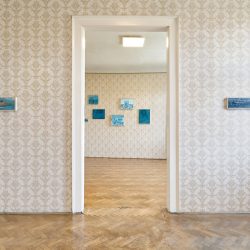
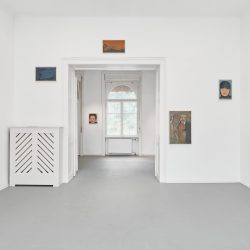
Longtermhandstand presents the major retrospective exhibition titled “Once, there was a radio program about dream interpretation. I called in and asked, ‘How is it that everything I dream always comes true?’” from the oeuvre of Omara (Mara Oláh, 1945–2020), the most influential Hungarian Roma female painter of the 20th and 21st centuries.
Spanning both floors of the gallery—a first in Longtermhandstand’s history—the exhibition presents key works and series that encompass the full arc of Omara’s career. In 1988, at the age of forty-three, following her mother’s death, Omara began to paint. Art became for her a means of healing, processing trauma, and confronting herself.
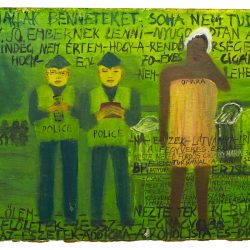
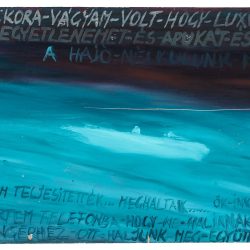
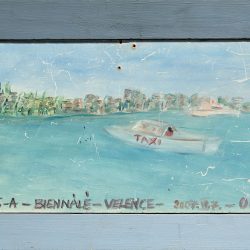
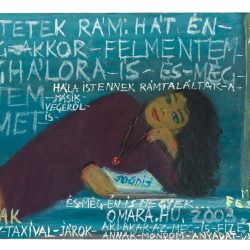
Omara was officially self-taught, working without formal training, yet she created a unique artistic language and visual world. The primary and consistent sources of this were her own life and experiences: memories of motherhood, illness, poverty, racist violence, and the daily struggle for survival took shape in her vivid, figurative paintings. Starting in 1992, after one of her works was misinterpreted at an exhibition in Szeged, she began painting handwritten inscriptions directly onto the surface of her paintings: statements, expressions of outrage, confessions, and confrontations, so that no one but herself could interpret her works.
Her paintings simultaneously convey tender, personal confessions and fierce political protest. As part of the exhibition, we will showcase, among other works, Omara’s iconic “blue paintings”: intimate works painted in various shades of blue, born from a dream she had about her daughter, which bear witness to the hardships of being a Roma woman and a member of a minority.
Her important political paintings will also be on display, addressing social issues such as police brutality, institutional racism, and housing inequalities. Visitors can also view her performative self-portraits, in which she appears as a devoted mother, a celebrated artist, a naive painter, or a dazzling public figure, as well as her characteristic miniature paintings created on the insides of cigarette packs cut open between 2010 and 2020 and other pieces of cardboard.
The title of the exhibition is a question Omara posed during a live call to a radio dream interpretation show, and it encapsulates the prophetic nature of both her work and her life: Omara did not merely document her reality, but professed with complete conviction that it could be changed, and she literally painted her dreams into reality.